
Company Updates

Josh Kirkham, VP of Operations

Last updated:
July 2026
Read time:
8
mins
Hey CoRecruiters!
It's been a busy, busy time for everyone in the recruitment industry — and we wanted to know how it's playing out on your desks. So in late 2025, we surveyed 159 recruiters and agency owners to measure the real impact CoRecruit is having.
The survey results are out, and we absolutely love them!
Here's everything we found.
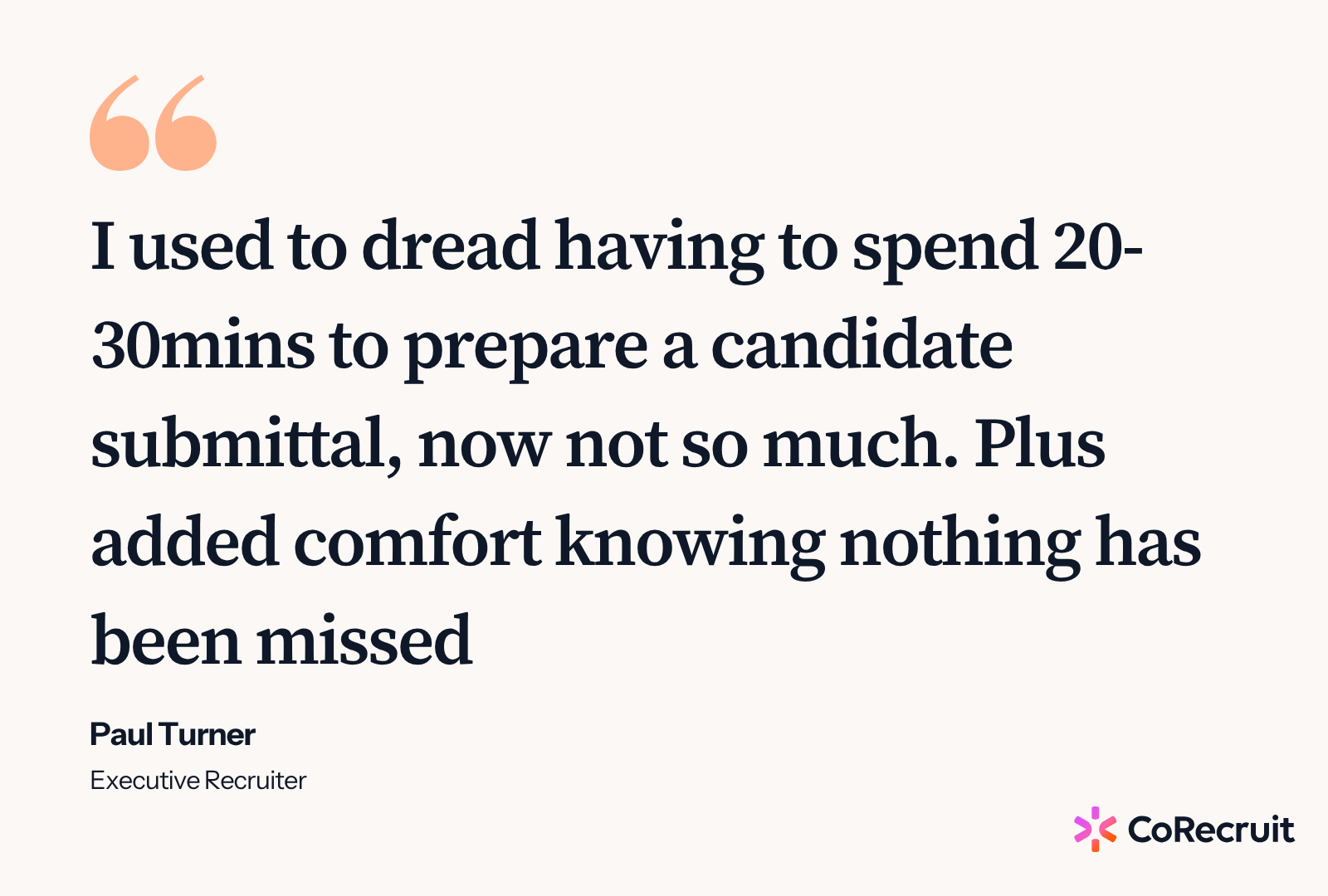
Before CoRecruit, the majority of our users were spending 20 to 30+ minutes preparing a single candidate submittal. Every. Single. One.
Think about what that means at scale. Ten submittals a week? That's up to five hours gone. Not on sourcing, not on client calls, not on strategy. On formatting notes and filling in fields.
After CoRecruit, that same submittal takes under ten minutes. Most users are getting it done in under five.
That's a 75% reduction in time per candidate. We love it!
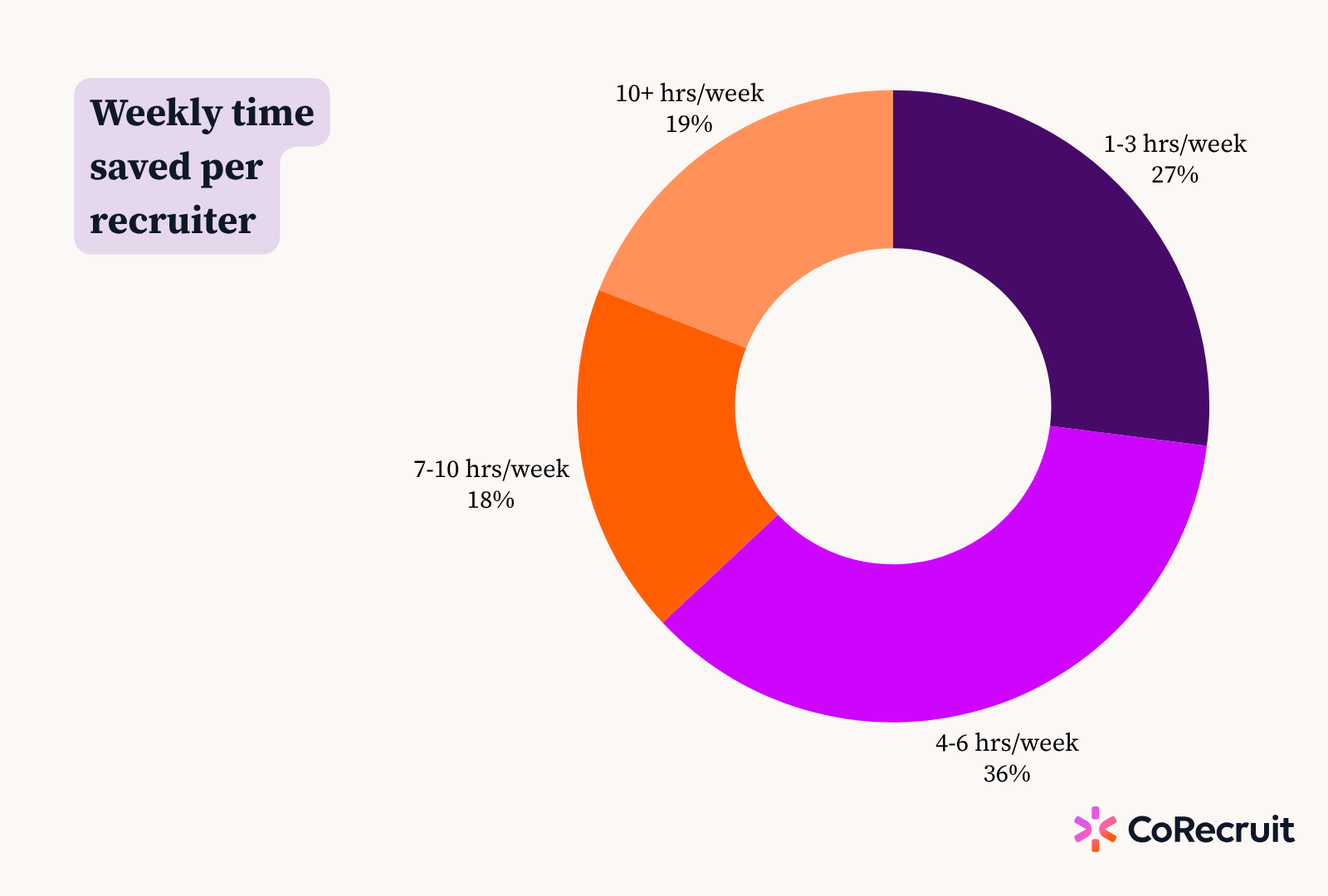
73% of our users are saving four or more hours every week.
Let me break that down further:
Only 27% are in the 1–3 hour range. The majority are getting back nearly a full working day every week.
This is the part I find most compelling, and most telling about the recruiters who use this tool well.
When we asked users what they do with their recovered hours, the top three answers were:
Nobody said they were using the time to do more admin. Nobody said they were just leaving early (though honestly, fair enough).
The best recruiters are immediately reinvesting saved time into the things that grow a business, their business relationships, the pipeline, and everything else that plays a huge role in their agency’s growth.
That's the compounding effect that doesn't show up in a single survey, but it will show up in revenue over the next 12 months.
I'm going to be straight with you here, because I think honesty is more useful than spin.
36% of users reported increased placements per month. 34% reported increased revenue per recruiter. The rest reported no change or were unsure.
Does that mean CoRecruit isn't driving revenue? No. It means revenue is a lagging indicator.
When a recruiter saves four hours a week and reinvests that time into client relationships and sourcing, the placement impact takes months to compound. The efficiency gain is immediate. The revenue follows.
What is showing up right now: ~40% of users reported an increase in call volume per recruiter. That's the leading indicator. The revenue follows.
95%+ of respondents listed the AI Notetaker as their most important feature.
Not a nice-to-have. The anchor of the product.
Why? Because 81% of users rated CoRecruit's impact on candidate experience as 8/10 or higher.
And when we dug into the qualitative data, the reason was consistent: recruiters are finally able to maintain eye contact during interviews. They're listening and they’re actually listening, not half-typing and half-nodding.
That changes the quality of the conversation. It changes the candidate's perception of the agency. And it changes the data that ends up in the CRM — because notes taken by someone paying full attention are better than notes taken by someone trying to multitask.
Average NPS: 8.8 out of 10.
68% of users are Promoters. The kind of satisfaction that leads to referrals and case studies and unprompted LinkedIn posts. 21% are Passives. 11% are Detractors, and their feedback was almost entirely about mobile limitations and AI voice calibration, which are things we're actively working on.
The satisfaction is high. And it's coming disproportionately from agency owners and partners (~45% of respondents), the people who see the efficiency gains hitting their bottom line directly.
Here's my read on all of this:
The agencies that win over the next three years will be the ones that get the most out of the people they already have.
The admin burden that's been baked into recruiting for decades (the note-taking, the CRM updates, the submittal formatting) is not a cost of doing business anymore. It's a choice. And increasingly, it's a competitive disadvantage.
Our users are choosing differently, and we’re thrilled to make that happen.
CoRecruit conducted this survey across 159 users in 2 months. Respondents included agency owners, recruiters, directors, and team leads across staffing and executive search.
.svg)


%20LG.svg)

.svg)


