
AI in Recruiting

Josh Kirkham

Last updated:
April 2026
Read time:
7
mins

Most recruiters throw the term “most placeable candidate” around loosely. This is a problem because recruiters end up treating every candidate like a priority, which means none of them actually are.
An MPC isn't just a good candidate. It's a specific designation, and if you apply it to everyone, it means nothing.
Here's what an MPC is, how to use one, and what separates the recruiters who make it work from the ones who don't.
A most placeable candidate (MPC) is a job seeker you can call any hiring manager about today and generate genuine interest in, even if that hiring manager wasn't looking to hire.
They’re the kind of person where the pitch writes itself.
The fastest litmus test to see if the candidate can be categorized as an MPC: if you sent this person's resume to five hiring managers right now, would at least three want to bring them in?
If yes, that's an MPC.
The MPC strategy works because it flips the traditional recruiting model. The traditional way is reactive where the client sends a job order -> recruiter goes to find candidates -> and the cycle continues until the role gets filled or not.
The MPC approach is proactive. You lead with a candidate so compelling that the conversation happens before the job order exists, i.e., you create the vacancy.
A strong MPC gives you a legitimate reason to cold call any company in your niche today. It also generates market intelligence whether the call converts or not. You learn who's hiring, who isn't, what roles are coming, which firms use recruiters. One well-run MPC call can build out your database faster than a week of research.
A candidate can have a brilliant background and still be impossible to place. Salary expectations three bands above market. Interviewing with twelve other agencies. Takes 48 hours to return a call. None of that is an MPC.
The following criteria is what makes someone an MPC:
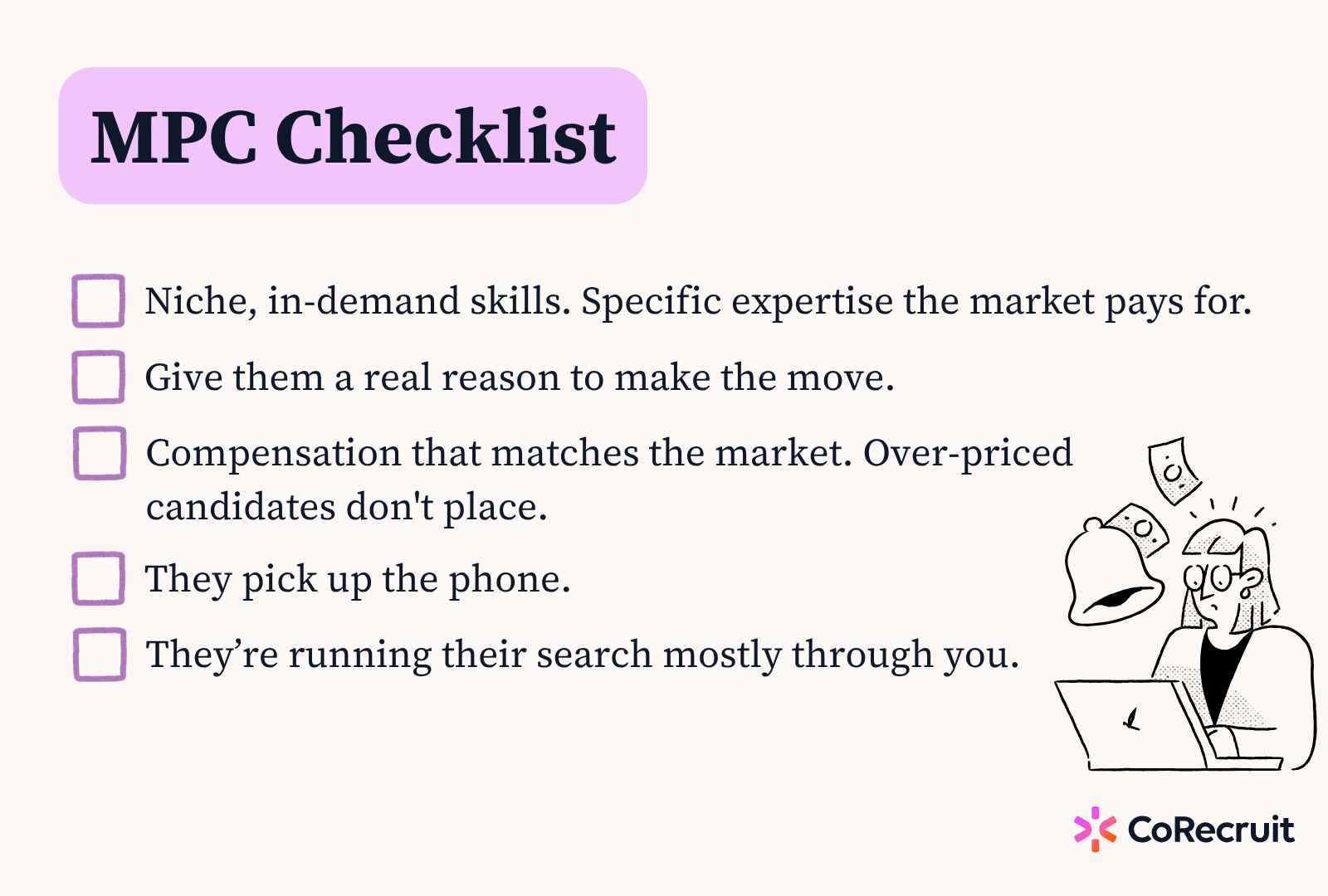
They don’t have general experience, but possess specific expertise the market is actively paying for.
Examples:
They need a real reason to leave and not just curiosity about what's out there. This reason can be a pending layoff, a company going through change, a ceiling they've hit. But it has to be something concrete. Vague openness doesn't hold up when a hiring manager wants to move ahead.
Over-priced candidates aren't MPCs. If their expectations are out of range for the market, the placement falls apart at the offer stage and everyone's wasted their time. Responsiveness is a proxy for everything else.
They pick up the phone. They show up prepared. They can tell their own story clearly. That is an important trait because you're going to be speaking on their behalf and you need confidence in what you're saying.
If they're working with six other agencies, you have no control over the timeline. Another recruiter submits them first and the placement is gone. The best MPCs work mostly through you. At minimum, you need to know exactly who else has them and how far along those conversations are, so you're never caught off guard by an offer you didn't see coming.
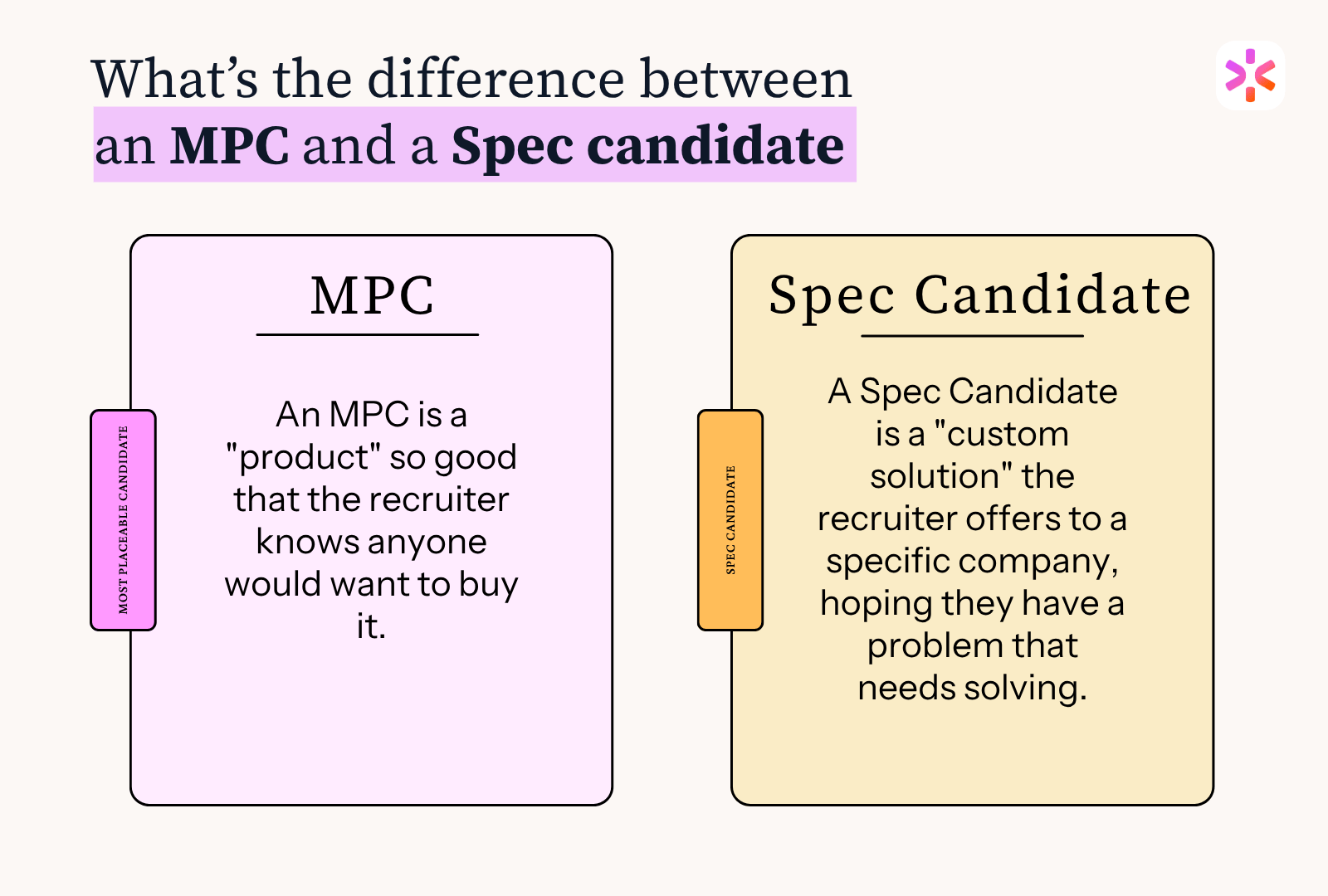
In the recruitment industry, MPC and Spec Candidate are terms used to describe how a recruiter presents a candidate to a potential employer before a formal job order or contract is actually signed.
While they are closely related and often used interchangeably, there is a subtle difference in intent and quality.
An MPC is the "gold standard" of candidates in a recruiter’s database. They are individuals who are so highly skilled, well-priced, and in-demand that they are likely to be hired quickly by almost any company in their specific niche.
A Spec Candidate is a person sent to a specific company "on spec" (speculatively). This means the recruiter is sending the resume without a formal job opening being advertised, but with the hunch that the candidate fits the company's culture or potential needs.
Lead with what the candidate makes possible for the company, and not with their resume. Here’s how:
First, there's a difference between listing what a candidate has and selling what they make possible.
"Seven years in mechanical engineering, PE license, ASHRAE certified" tells the hiring manager nothing they care about. This is a resume summary, so it’s nothing of importance to them.
Compare that to: "How would you like to interview the number one sales rep from your direct competitor?" One sentence that has no credentials listed is a direct hit on what the hiring manager wants. That exact line can result in a placement and a client relationship that lasts years.
The principle is simple. Before you open your mouth to pitch someone, ask yourself what this candidate makes possible for the company. Is it more revenue, a problem finally solved, a loophole that's been open too long. Lead with that.
An example that can work:
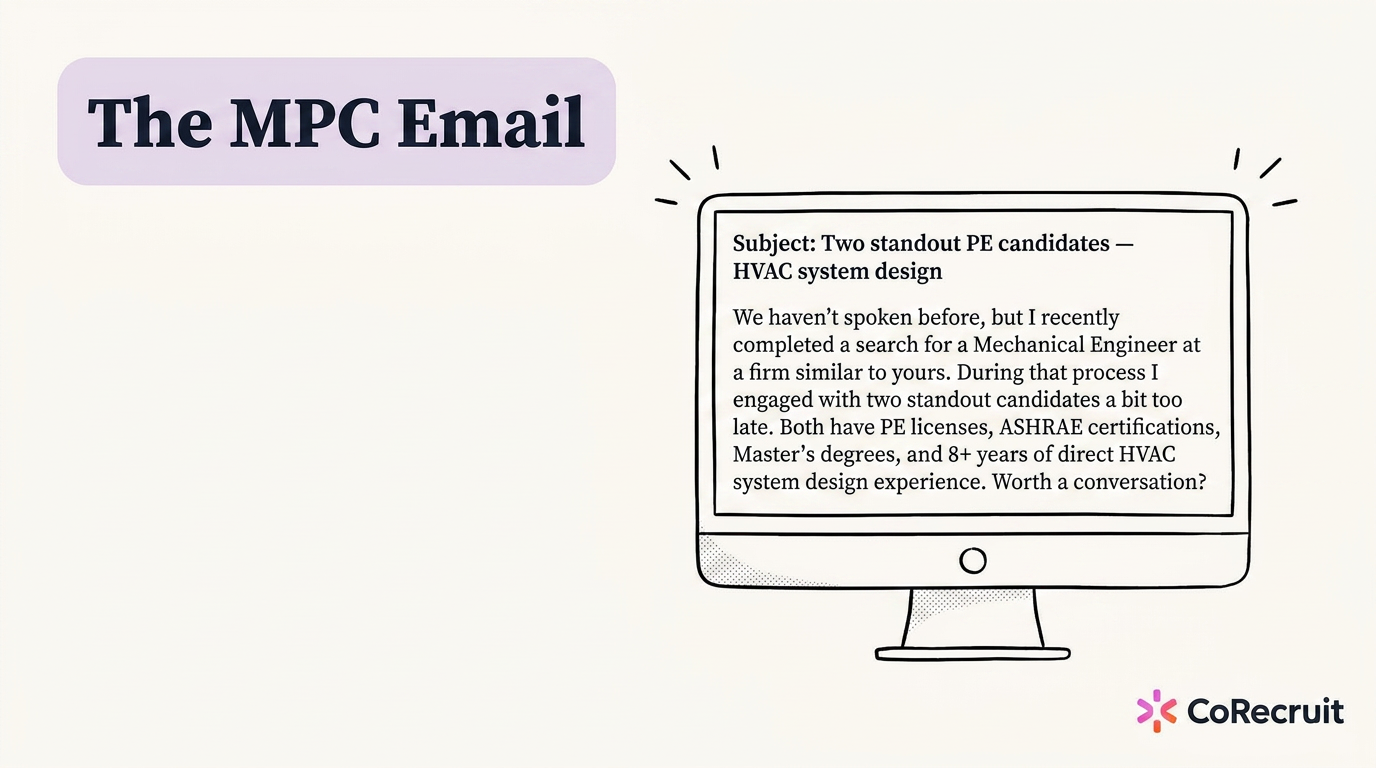
"We haven't spoken before, but I recently completed a search for a Mechanical Engineer at a firm similar to yours. During that process I engaged with two standout candidates a bit too late. Both have PE licenses, ASHRAE certifications, Master's degrees, and 8+ years of direct HVAC system design experience. Worth a conversation?"
This is to the point, thus, easy to say yes to.
Every MPC call is a call to a hiring manager where you lead with a candidate to start a conversation. The placement is the goal, but it's not the only outcome you can achieve.
Even when the hiring manager isn't interested in your specific candidate, a well-run call should still tell you whether they're hiring or have headcount coming, whether they use external recruiters and on what terms, who else in the company or division is worth speaking to, and which other recruiters are already working their space.
And always connect on LinkedIn before you hang up.
The MPC call is a door opener. What you do once the door is open determines whether it becomes a one-off placement or a long-term client.
Some recruiters create fictional candidates to warm up a prospect, then pivot once the hiring manager shows interest: "that candidate is no longer available, but I have someone similar."
Some see it as a conversation starter. Others call it what it is: misleading.
The practical problem, separate from the ethics, is that it's hard to sell with conviction when the person doesn't exist. The calls that convert are the ones where the recruiter is genuinely excited. You can't fake that at scale.
If you don't have a real MPC right now, build a credible composite pitch — "I've been speaking with several candidates in this space recently" and keep it honest. It still opens the conversation.
Traditional MPC identification was a gut call. Experienced recruiters developed instincts, but those instincts didn't scale and introduced bias toward whoever they'd spoken to most recently.
Modern recruiting platforms track behavioral signals that indicate candidate intent: re-engagement with job alerts, return visits to open roles, responses to outreach. A candidate who visits your job board three times in a week and opens your last two emails is telling you something (even if they haven't picked up the phone yet).
AI matching can also score candidates against active job orders before a human reviews them, surfacing high-fit people buried in a database. Tools like CoRecruit go further, capturing notes and context from every candidate conversation, so when someone re-enters the market, recruiters aren't starting from scratch.
The best MPC strategies combine the recruiter's judgment with live signals from the data. Neither one alone is enough.
.svg)


%20LG.svg)

.svg)


