
AI in Recruiting

Josh Kirkham

Last updated:
April 2026
Read time:
7
mins
Recruitment firms using AI at any stage of the recruitment process are 3.5 to 4.5 times more likely to have grown revenue last year (source: Bullhorn's 2026 GRID Industry Trends Report). The firms behind those numbers share one thing: they run lean, and they run fast. Boutique executive search firms are built exactly that way.
Big agencies have global databases, research teams, and brand recognition that takes decades to build. Boutique firms have deep niche expertise and client relationships that never get handed off. The one area where boutiques have historically been outgunned is capacity: how many searches they can run at once, how fast they can build a longlist, how much admin eats into billable time. AI is the direct answer to that.
In short, AI removes the capacity ceiling that used to cap how much a small firm could take on.
A boutique executive search firm is a small, specialist recruiting agency that focuses on a specific industry, function, or seniority level — typically owning one niche deeply rather than covering all sectors.
A boutique executive search firm is a small, specialist recruiting agency focused on a specific industry, function, or seniority level. Where a global firm might place everyone from analysts to C-suite across every sector, a boutique firm typically owns one niche, like healthcare leadership, private equity CFOs, supply chain executives.
The model is built on expertise and relationships rather than scale. Clients come to boutique firms because they want a recruiter who genuinely understands their world, and not a generalist running a process.
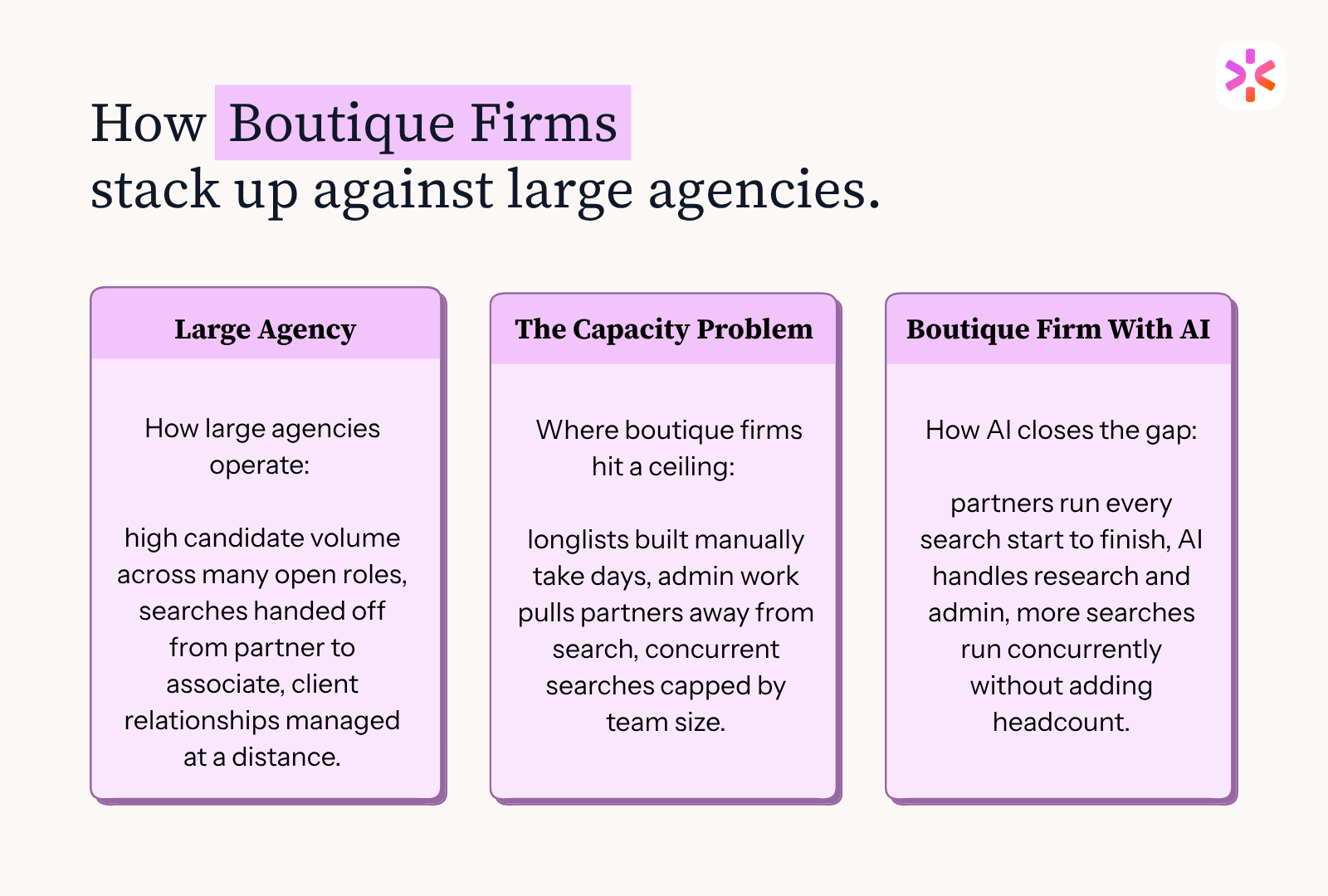
Large recruitment agencies run high volumes. They have targets, territories, and layers of management. The partner who sells the engagement is rarely the person doing the work. Candidates get handed off. Context gets lost. At the C-suite level, that costs mandates.
Boutique firms work differently. The person who takes the brief runs the search. Clients get direct access. Candidates get a recruiter who knows the market they're placing into, one who can speak to culture, compensation norms, and which companies are worth talking to.
When a search needs to close, it closes. No internal approvals, no competing priorities across a hundred open roles.
The limitation has always been capacity. A two-partner boutique can only run so many concurrent searches before quality drops. Building a longlist manually takes days. Updating records, writing notes, scheduling, formatting candidate profiles, and all of it eats hours that should be spent on search work.
That's where large agencies, with dedicated research teams and coordinators, have historically pulled ahead.
According to Bullhorn's 2026 GRID Industry Trends Report, recruitment leaders rank the ability to scale without adding headcount as the top operational benefit of AI. That's the boutique firm's exact problem, and AI is the direct answer to it.
For boutique firms specifically, AI changes the equation in four ways:
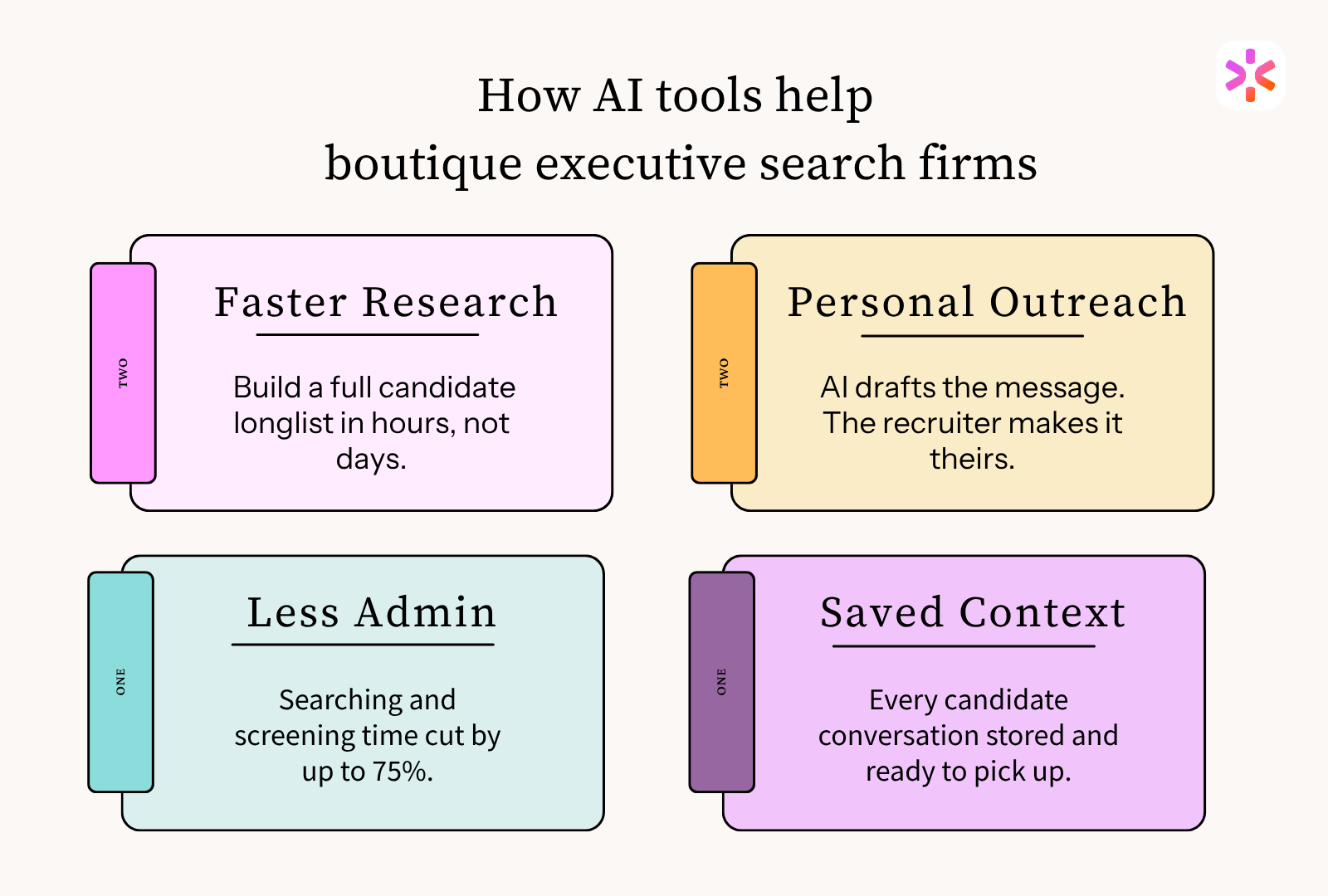
Building a candidate universe for a CFO search used to mean hours of manual LinkedIn work. That included cross-referencing titles, companies, tenure, and location one profile at a time. AI-assisted sourcing pulls together a candidate universe in hours rather than the days it takes to build one manually. Thus, giving boutique executive search firms the research depth that previously required a dedicated research team.
Bullhorn's 2026 GRID report found that most recruiters say AI is reducing the time they spend on searching and screening candidates by 26–75%. For a boutique firm, that time goes directly back into search work: candidate conversations, client updates, and the assessments that help move a mandate forward.
Executive candidates notice generic sequencing immediately. The right approach isn't mass automation, but it's using AI to draft highly personalised outreach that the recruiter refines before sending. The candidate experience stays high-touch. The time saved per outreach cycle compounds into meaningful outcomes.
At the executive level, a missed follow-up or an underprepared candidate briefing costs mandates. A CRM for boutique executive search firms needs to do more than store contact details: it needs to hold the full picture of every relationship.
(Side note: CoRecruit takes context from every conversation automatically, so when a candidate re-enters the market six months later, the recruiter picks up exactly where they left off.)
A boutique executive search firm running a VP of Sales mandate once needed one partner on client relationships, one researcher building a longlist manually, and one coordinator on scheduling and admin. Capacity maxed out at three or four concurrent searches before quality started slipping.
With AI handling the research and admin layers, that same three-person firm runs six to eight searches concurrently without adding headcount. The partners spend their time on the work only they can do: the candidate conversations, the judgment calls, the client relationships that secure the next mandate.
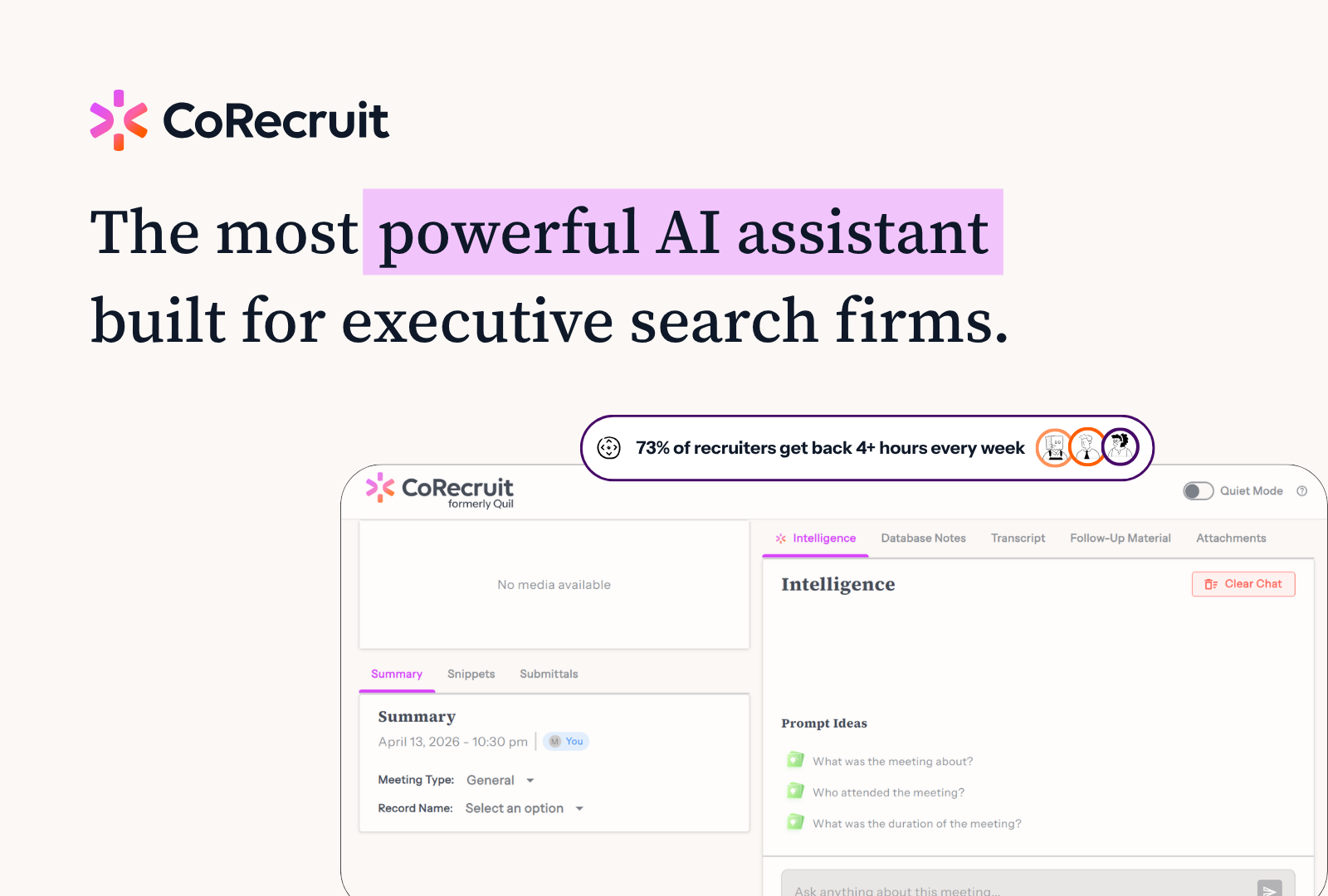
According to CoRecruit's survey of 159 staffing and recruiting professionals, 73% of users get back four or more hours every week.
The three things they consistently do with that recovered time:
1. Build stronger client relationships
2. Source more candidates
3. and focus on revenue-generating work.
Placement impact takes time to compound. But 40% of those same users reported an increase in call volume per week. For a boutique executive search firm, more calls means more mandates in the pipeline. That's where the revenue growth starts.
And 51% of recruitment leaders say AI is already helping them identify better candidates faster — with more time to connect with clients and candidates coming in as the second biggest reported benefit. For boutique firms, that second point is the whole business model.
AI can surface candidates. It can't tell you which CFO is genuinely ready to leave and which one is taking calls out of curiosity. It can draft an outreach message, but it can't build the trust that makes a passive candidate take a meeting. It can summarise a brief, but it can't sense when a client's stated requirements and their actual priorities don't match.
That's the boutique firm's permanent advantage: the niche expertise and relationship depth that no global agency can replicate at speed. AI amplifies that expertise. It doesn't replace it.
Waiting on AI adoption is where boutique firms lose ground. Every month without it is a month a competitor runs more searches, responds faster, and takes mandates that could have been yours.
.svg)


%20LG.svg)

.svg)


