
AI in Recruiting

Minahil Mansoor

Last updated:
August 2026
Read time:
9
mins
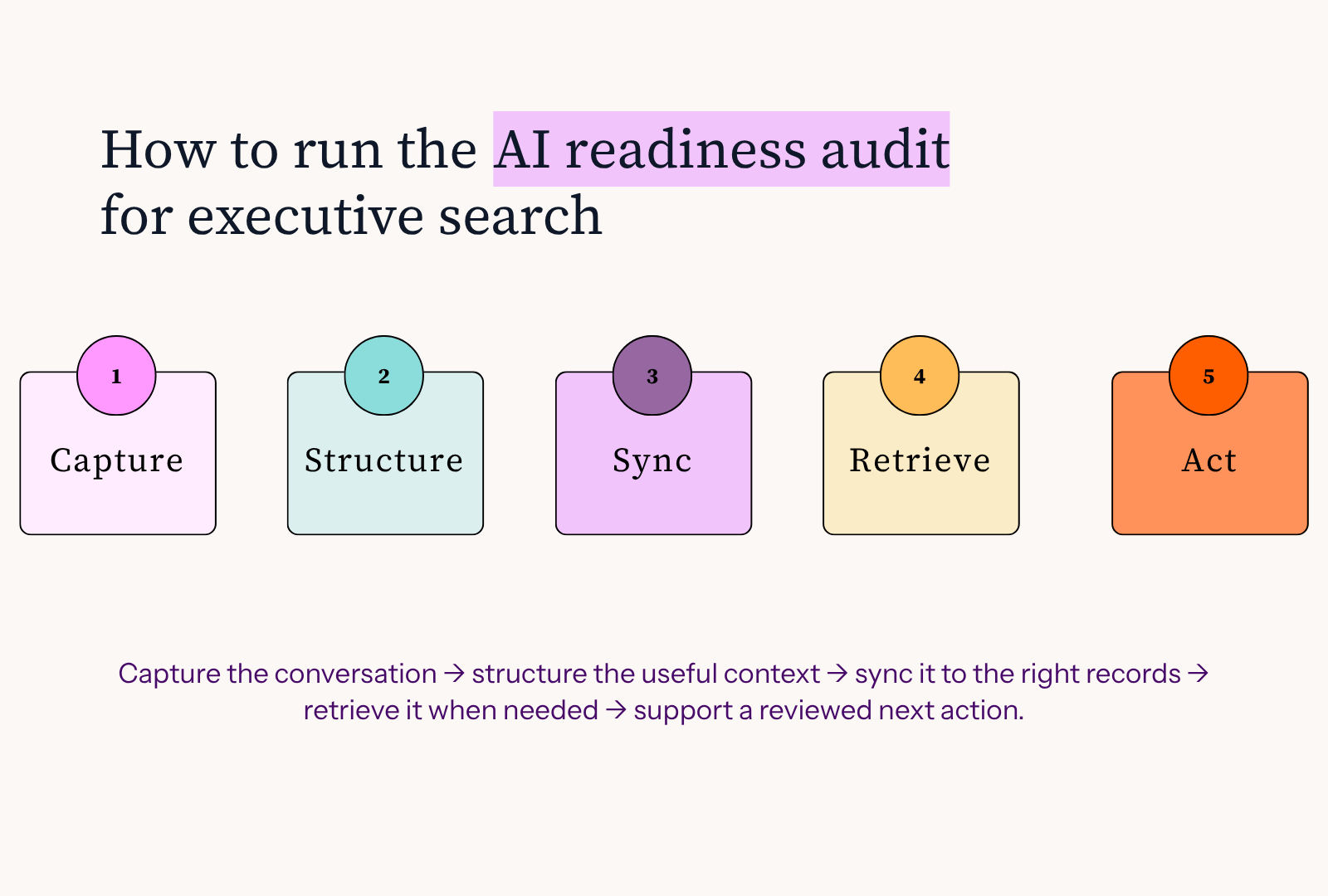
AI pilots at executive search firms don't work (mostly) because nobody defined what "working" would look like before the pilot started. Here’s a scenario: A recruiter tries a new tool for a few weeks, some people like it, some don't, and six months on nobody can say whether anything changed.
An AI readiness assessment fixes the order of operations: define the problem and the metric first, run the pilot second, and score the result against the same five things every time, so the answer doesn't come down to a gut feeling in a Monday meeting.
It doesn't mean having the newest tool or the biggest AI budget. It means five specific things are in place before a pilot starts, and still in place 30 days later:
Firms that skip straight to "let's try this AI tool" without these five in place are the ones whose pilots quietly die. Firms that score themselves against all five, twice, tend to have something real to show leadership at the end.
The most common failure point isn't the tool, it's skipping this step entirely. Before evaluating any AI product, a desk should be able to name one recurring constraint that's genuinely limiting capacity, quality, conversion, or client responsiveness, and pick a single high-frequency, low-risk workflow to fix first. That workflow needs a clear start and end point, a known current performance level (not just "it feels slow"), one outcome metric, one quality guardrail, and one person who owns all three.
Without this, a pilot has no way to succeed or fail. It just runs.
This is where trust gets built or lost. Recruiters and clients need to know which tools are approved, what data those tools can touch, and when consent is required before a conversation gets recorded or summarized. Someone specific needs to be accountable for reviewing output before it reaches a client, and there needs to be a clear path for what happens when the output is wrong.
The ATS has to stay the system of record through all of this, whether that's Bullhorn, JobDiva, Avionté, Crelate, TempWorks, or something else. The moment AI-generated notes live somewhere the rest of the team can't see them, the firm has created a second, disconnected version of the truth, which tends to cost more time than the AI saved.
Governance here isn't abstract. It means specific answers to specific questions: does candidate consent language cover AI-assisted screening and automated SMS follow-up, the way TCPA and a growing list of state laws expect it to? Is I-9, W-4, and background check documentation handled the same way for every client, so an AI agent can verify completeness without guessing at exceptions? Is candidate PII, social security numbers, contact details, work history, processed through a pipeline genuinely built for it, rather than pasted into a general-purpose chat tool? A firm that can answer all three has governance. A firm that can't has a pilot waiting to become a liability.
A transcript is not the same as intelligence. The bar is higher: does the output give a colleague something they can use, a next action, an owner, a date, a distinction between what the recruiter judged and what the AI summarized? Good AI output reduces re-keying. Bad AI output creates a second admin task that looks like progress but isn't.
Adoption isn't a training problem, it's a fit problem. If the pilot group understands the workflow and it fits naturally into how they already work, adoption follows. If it doesn't, no amount of onboarding fixes it. The way to know which one is happening is to review a small, real sample of output every week, specifically for usefulness and tone, not just whether a field got filled in. A complete record and a genuinely useful one are not the same thing, and it's worth tracking the difference.
This is the step that turns a pilot into a decision. One primary metric, one quality guardrail, tracked the same way at the start and 30 days later. If a firm can't point to a number that moved, the pilot doesn't get to graduate into "how we do things now," regardless of how much people liked using it.
CoRecruit's AI Implementation Scorecard is for: the same five categories, but 25 specific statements scored 0 to 4, once as a baseline and once at day 30. The difference between the two scores is what holds up in a conversation with whoever has to approve scaling a pilot past a trial.
Try it here: https://corecruit.com/ats-scorecard-executive-search


.svg)


%20LG.svg)

.svg)


