
AI in Recruiting

Minahil Mansoor

Last updated:
July 2026
Read time:
11
mins
Third-party recruiters spend more time on documentation than on candidate conversations.. The average recruiter is still manually typing call notes, copy-pasting candidate details into submittals, and updating ATS records by hand in 2026.
None of that needs to be human work anymore.
This guide covers what AI recruiting tools are, the different types on the market, how they fit into a real staffing workflow, and which ones are worth the investment for agencies versus which ones were built for in-house TA teams and will disappoint you in a third-party context.
An AI recruiting assistant is software that uses artificial intelligence to handle tasks that would otherwise sit on a recruiter's plate. That covers anything from transcribing a candidate call to generating a formatted submittal and pushing it directly into the ATS.
The category is broad. Some tools solve one specific problem, scheduling, for example. Others cover the full workflow from sourcing through to ATS update. What they share: they process the same information a recruiter works with, calls, CVs, job briefs, ATS records, and either automate an action or surface something useful from it.
The more important distinction is between tools that sit alongside a workflow versus tools that are embedded in it. A tool that generates a candidate summary but requires a recruiter to manually copy it into Bullhorn has moved the problem, not solved it. The real time savings come from tools that act on data and update records automatically.
1. Admin and documentation tools
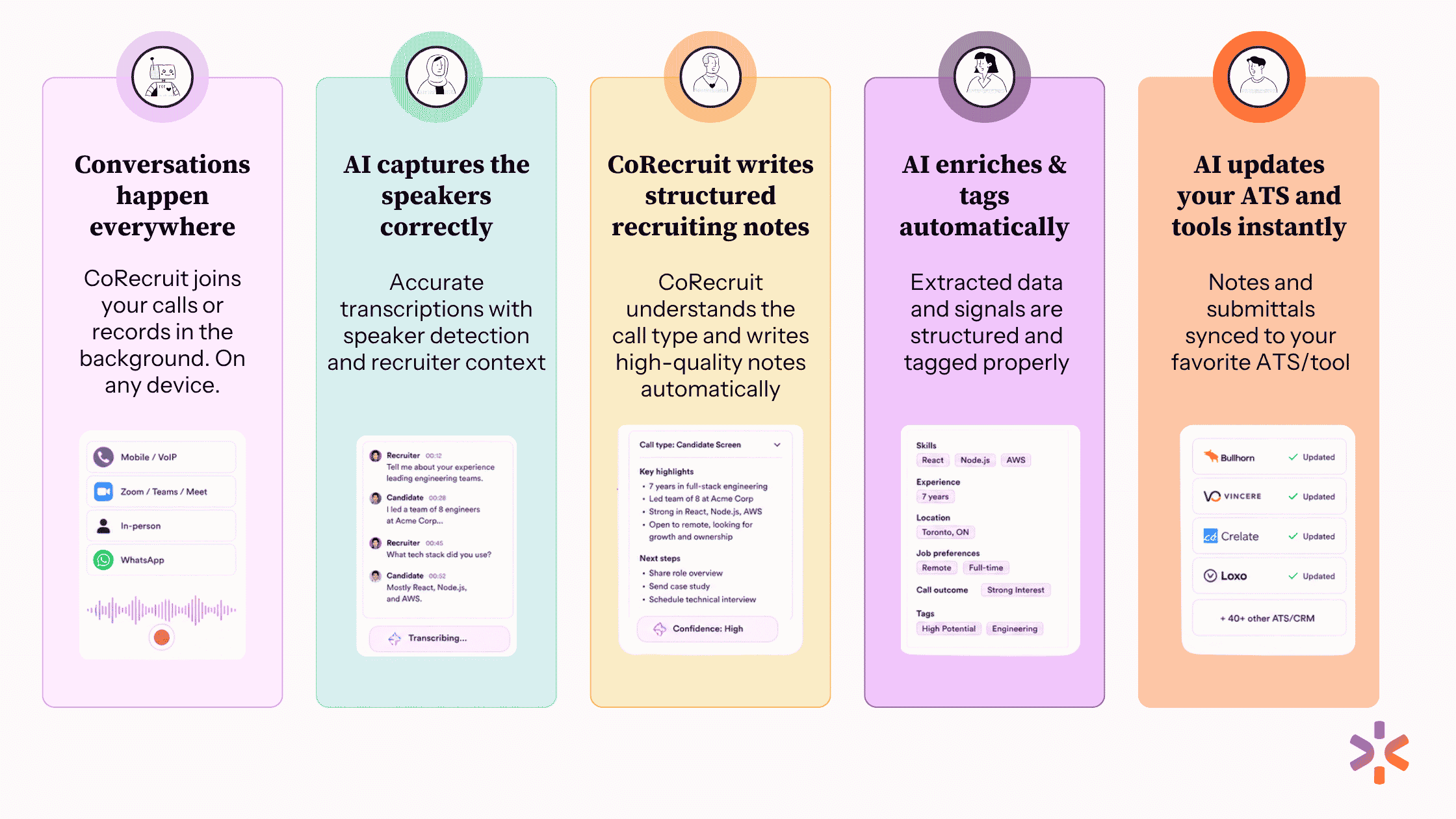
These handle note-taking, call summaries, candidate profiles, and ATS data entry. A recruiter finishes a call and the tool produces a structured summary, extracts the relevant details, and writes them into the appropriate ATS fields, no manual input required.
CoRecruit sits in this category. It records phone calls without a bot joining the call, transcribes and analyses the conversation, generates a candidate submittal, and writes the output directly back to Bullhorn and 20+ other ATS platforms. For agencies where 91% of recruiter conversations happen over the phone, this is the highest-leverage automation available.
2. Sourcing tools
These search job boards, LinkedIn, and internal ATS databases to surface candidates matching a job brief. The strongest implementations let recruiters query their existing candidate database in natural language instead of running Boolean searches.
CoRecruit's MCP connector does this, a recruiter can ask "who in our database has 8+ years in financial services and is open to relocation" and get a structured shortlist back instantly, without touching the ATS search interface. The caveat: sourcing AI is only as good as the data underneath it. Agencies with clean, current ATS records get significantly more value than those with patchy data hygiene.
3. Screening tools
AI resume screening tools parse CVs and rank candidates against job criteria. High-volume roles, logistics, healthcare, light industrial, benefit most. Executive search, where the candidate pool is narrow and qualitative judgment is the whole point, benefits least. Know your use case before buying into this category.
4. Interview and call documentation tools
The market splits into two types here, and the distinction matters more than most vendors will tell you:
Bot-based notetakers (Fireflies, Fathom, Otter) join a call as a visible third participant. Fine for internal meetings. Actively damaging on candidate and client calls, where a "Fireflies Bot has joined" notification signals that the recruiter is routing the conversation through a third-party tool.
Botless recorders work in the background, no bot joining, no participant notification. CoRecruit uses botless recording for exactly this reason. Candidate and client calls are professional relationships, and a bot joining those calls damages trust in ways most recruiters don't notice until they've already lost it.
5. Scheduling tools
These automate the back-and-forth of booking interviews, connecting recruiter, candidate, and hiring manager calendars and firing confirmation messages automatically. Lower complexity than most other categories, standalone tools like GoodTime and Calendly handle this well without needing a full AI recruiting platform.
6. Candidate engagement tools
Chatbots that communicate with candidates between touchpoints: application confirmations, status updates, interview reminders. Primarily useful in high-volume staffing. In retained executive search, automated candidate communications can actively damage relationships. These tools are not one-size-fits-all, and agencies should be honest about which end of the volume spectrum they operate on.
7. Analytics tools
AI that identifies patterns across a recruiter's pipeline, which sourcing channels convert, where candidates drop off, what backgrounds lead to successful placements. Useful for agencies with enough data volume to surface meaningful patterns. For smaller firms running 20–30 active roles, the insights tend to be thin.
Most third-party recruitment workflows follow the same arc: job brief → sourcing → screening → outreach → candidate call → submittal → placement.
AI tools can plug in at every stage, but the highest-value interventions for staffing agencies are almost always in documentation and data entry, the tasks that consume the most time and produce the least strategic value.
Here's where the ROI is clearest:
During the candidate call: An AI notetaker records and transcribes the conversation, extracts relevant details, skills, availability, salary expectations, red flags, and structures them for ATS import. The recruiter stays focused on the conversation instead of split between listening and typing notes.
After the call: The tool generates a formatted candidate submittal or profile. CoRecruit users report reclaiming 4+ hours per week at this stage alone, time that goes back into sourcing and client development.
ATS update: Direct write-back to the ATS means records stay current without a separate data entry step. This matters for data hygiene and for any recruiter who's ever lost a placement because a candidate record was three months out of date.
Database querying: CoRecruit's MCP connector lets recruiters query their candidate database in natural language, surfacing relevant profiles without manual ATS searches. The database becomes usable again instead of a graveyard of old records.
ATS integration depth. "Integrates with Bullhorn" can mean anything from a full bidirectional sync to a CSV export. Ask specifically: does the tool write data into ATS fields automatically, or does a recruiter still need to do something after? The answer determines whether you're buying automation or a slightly faster copy-paste.
Phone-first vs. meeting-first. Most AI notetakers were built for video meetings, Zoom, Teams, Google Meet. Staffing agencies run on phone calls. A tool built for meetings will produce poor transcription quality on phone audio and may not record calls at all without a workaround. Verify this before signing anything.
Bot vs. botless recording. Covered above. For candidate and client calls, botless is the professional standard.
Built for in-house or third-party? In-house TA tools are optimised for hiring managers, structured interview scorecards, and internal approval workflows. Third-party tools are optimised for fast candidate turnaround, client submittals, and multi-client pipelines. Metaview is built for in-house teams, it won't produce a formatted submittal or update a third-party ATS the way CoRecruit does.
Implementation time. A tool that takes three months to configure before delivering value is a risk for a lean agency. CoRecruit is designed to be live quickly, most agencies are using it in production within days.
The best AI recruiting tools don't change what good recruiting looks like. They change how much of a recruiter's day goes toward doing it versus documenting it.
For staffing agencies, the starting point is almost always the same: the phone call. Record it without a bot, transcribe it, generate the submittal, update the ATS. That loop, currently manual at most agencies, is where the most time is being lost, and where the fastest wins are.
.svg)


%20LG.svg)

.svg)


