
AI in Recruiting

Josh Kirkham

Last updated:
August 2026
Read time:
10
mins
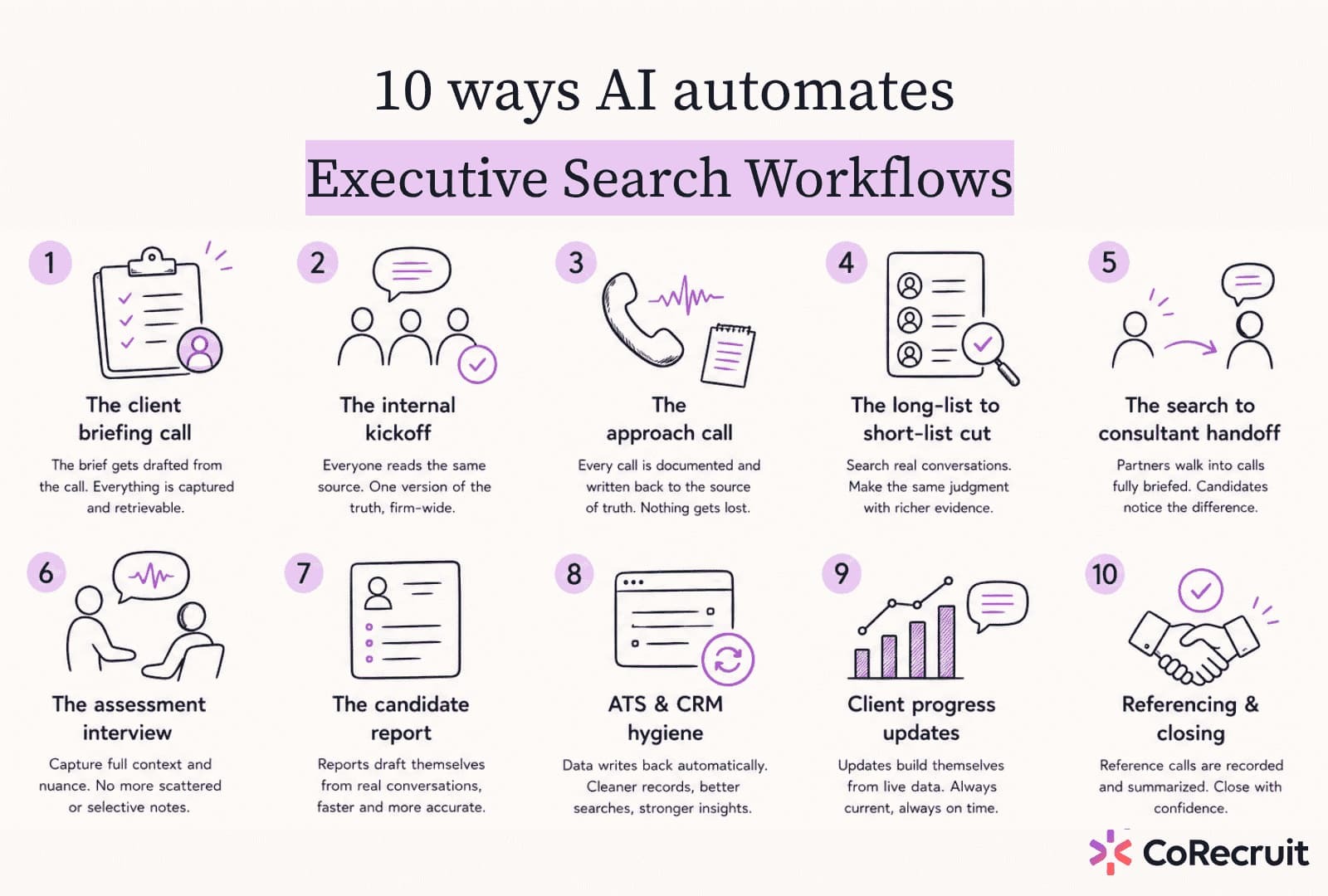
There's a specific moment in every retained search where information dies. For example, a recruiter finishes a 25-minute approach call with a target. A real conversation. The candidate said they're technically not looking, but mentioned twice that their new CEO has a different vision. They asked what the board composition looks like.
The researcher writes down: "spoke to candidate, not currently looking, revisit in Q4." Fourteen words from a 25-minute call. Every signal that counted just evaporated.
That happens four, five, maybe 10 times a day across a firm. It's not laziness, nobody has time to transcribe a call properly by hand. But the aggregate cost is that a firm's most valuable asset, live market intelligence, ends up living as a string of 14-word fragments.
Here are 10 places in a retained search where that happens, and 10 fixes, walked through a single search end-to-end.
Usually, a partner takes a 90-minute briefing with a board or CEO and writes the job spec afterward from memory and half-page notes. The spec ends up a rough compression of the conversation.
Automation: The brief gets drafted straight from the transcript of that call. Everything the client said about culture, about the predecessor, about what went wrong last time stays retrievable. Three months in, when a client says "we never said we needed manufacturing expertise," a consultant can check, politely. Firm president Tiffany told us her team uses this for intake and business development calls specifically, not just candidate work, because that's where the source of truth gets set.
This is another example. Normally, a partner briefs researchers verbally, researchers take their own notes, and two of four researchers end up with a slightly different mental model of the role.
Automation: Everyone reads the same source, the actual client briefing, instead of a partner's recollection of it. That removes an entire class of misalignment that usually surfaces in the long-list review three weeks later.
This is the one from the hook: a researcher takes 25-minute approach calls all week, logs 14 words per call, and the market map ends up as a spreadsheet of color-coded names.
Automation: Every approach call is documented in full, structured, and written back directly into the source of truth against that person's record, so it's findable later. The market map becomes a searchable body of real conversations. Lee, head of research at a private equity firm, described it as several hours a week of admin and ATS work reclaimed and redirected to sourcing and relationship-building. Worth naming the mechanism here: these calls almost always happen on the phone, not on Zoom, sometimes in person. A researcher catching someone between meetings needs a tool built for phone calls specifically, not one that only handles video meetings, or it misses most of the context a search runs on.
Normally, a partner reviews 40 names with 14-word notes attached and makes a judgment call on thin information.
Automation: Same judgment, richer evidence. A partner can search the actual conversations: who mentioned equity, who raised relocation. Worth being precise here, since it's central to the trust question: the tool isn't ranking candidates. The partner still makes the cut. They're just making it with full context instead of whatever a researcher happened to remember.
This transfer is the leakiest moment in the firm is when a researcher hands a bullet list to a partner, who then walks into a call with the CFO under-briefed, and it shows in the first four minutes.
Automation: The partner reads the actual prior conversations before the call. The candidate notices. That's the difference between a firm that feels joined up and one that feels fragmented. Paul, an owner-consultant in executive search, described the before-state plainly: manual notes and secondhand quotes meant some things got lost in translation; after implementation, that was resolved.
Normally, during a 90-minute competency interview, a partner types the whole time trying not to miss anything, then spends 45 minutes writing it up the next morning.
Automation: Full attention goes to the candidate during the interview, and a structured first draft is ready three to five minutes after the call ends. Survey data from CoRecruit's own customer base found 81% rated the impact on candidate experience an 8 out of 10 or higher, with recruiters citing eye contact and active listening as the reason. In executive search, where the interview is partly a sell, a partner who's visibly not listening is a commercial problem, not just an admin one.
Let’s talk about the candidate reports now. The deliverable is two to four pages per candidate, three to five candidates at a time, and it's the single biggest block of under-booked partner time at most firms.
Automation: A first draft is generated from the interview using a firm's own template; the partner edits it, and the judgment stays human. Brian, a managing partner, had this at 30 to 45 minutes per submission before.
Jamie, a managing director and search consultant, described the middle stretch of report generation and ATS entry as both gone. Across the customer base, prep time dropped from 20 to 30+ minutes to under 10 minutes on average. John, another managing partner, put the firm-level figure at one to two hours reclaimed per day.
Normally, this is the thing everyone puts off: notes that go in Friday, or next Friday, or never.
Automation: Paige described her team as routinely weeks behind on interview notes, with that backlog cleared within days once this was automated. Owen described the full chain: the call is recorded, the transcript produced, synced back into the ATS, and notes written into custom templates, all within minutes of hanging up. Across the customer base, 60% named automatic ATS write-back as a primary feature, and 20% named data accuracy and CRM hygiene as the KPI most improved by using CoRecruit.
Normally, on a Thursday afternoon, a partner reconstructs a week of activity from memory and calendar entries and writes an update vaguer than it should be. A client reads that vagueness as inactivity, which is how retained relationships quietly sour.
Automation: The week's activity already exists in structured form, so the update gets assembled, not reconstructed. Levi, a director at a mid-market firm, described saving multiple hours a week specifically on consolidating notes and producing client-ready output.
Normally, four reference calls per finalist get written up by hand, then a consultant has to remember every compensation signal across the last four months during closing conversations.
Automation: Reference calls are documented and structured the same as any other call. Every comp signal, every hesitation, every conditional a candidate mentioned weeks ago stays searchable, word for word. Offer stage is where searches die, usually on something that was said and forgotten.
Across the 10 workflows above, 73% of users save four or more hours a week, and 90% save 10 or more hours a week per person. When asked what they did with the reclaimed time: 70% said building stronger client relationships, 65% said sourcing more candidates, 55% said strategic or revenue-generating work.
But I’ll add two more points:
First, none of this makes a firm better at judging executive talent. The value is in the evidence layer, not the decision layer, and any vendor claiming otherwise is worth being skeptical of.
Second, the recording method counts more in this segment than any other. If a bot joins a call with a sitting CEO who's exploring a move, the conversation changes, and it can end the conversation outright. Recording without a bot on the line keeps things human to human, which is where most of the “actual” work happens.
.svg)


%20LG.svg)

.svg)


