
Comparisons & Lists

Josh Kirkham

Last updated:
September 2026
Read time:
13
mins
There are now hundreds of tools claiming to serve executive search. Most of them are general recruiting software with "executive" bolted onto the marketing copy: a job-req pipeline with a nicer logo, sold to firms whose actual product is a relationship and a Rolodex that took a decade to build.
Retained search doesn't run on job postings. A mandate might take three to six months, involve a shortlist of five to eight candidates who never applied anywhere, and end with a client paying a six-figure fee for judgment, not for keyword matching. The tools that earn a place in this stack have to fit that reality, not fight it.
This list covers the 9 worth evaluating in 2026, filtered down to what fits how retained search firms work: long cycles, off-list candidates, and a partner whose hour with each contact has to count.
That includes an honest read on when CoRecruit is the right answer, and when it isn't.
Let's start.
Start with what the firm does day to day, not what the category name promises. A generic ATS thinks in job reqs and pipeline stages: post a role, collect applicants, move them through stages. Executive search runs on mandates, off-list candidates, and relationships that get nurtured for months before a role even opens. If a tool's data model can't represent "we're not hiring for this yet, but we're building the shortlist," it's going to fight the firm instead of supporting it.
Normally: a partner finishes a 45-minute call with a candidate. They jot a few notes on a legal pad or in a half-finished email. Later that day, or more often the next morning, they or a researcher sit down to reconstruct the conversation from memory: what the candidate said about comp expectations, why they're open to a move, what gave the partner pause. That reconstruction is where detail gets lost, and it's an hour or more of billable time spent on data entry instead of the next call.
With AI: the call happens the same way, but it's recorded and structured in the background. Within minutes of hanging up, a summary, transcript, and structured note are sitting in the CRM against the candidate's record, formatted to whatever template the firm uses for that client. The partner moves to the next call.
That difference, multiplied across every call in a mandate, is where the 73% of users save 4+ hours a week.
Let’s look into these tools a bit more.
This is the layer that turns a partner's conversation into structured data without anyone typing notes. For search firms, it's the layer with the widest distance between what firms wish happened and what happens without help.
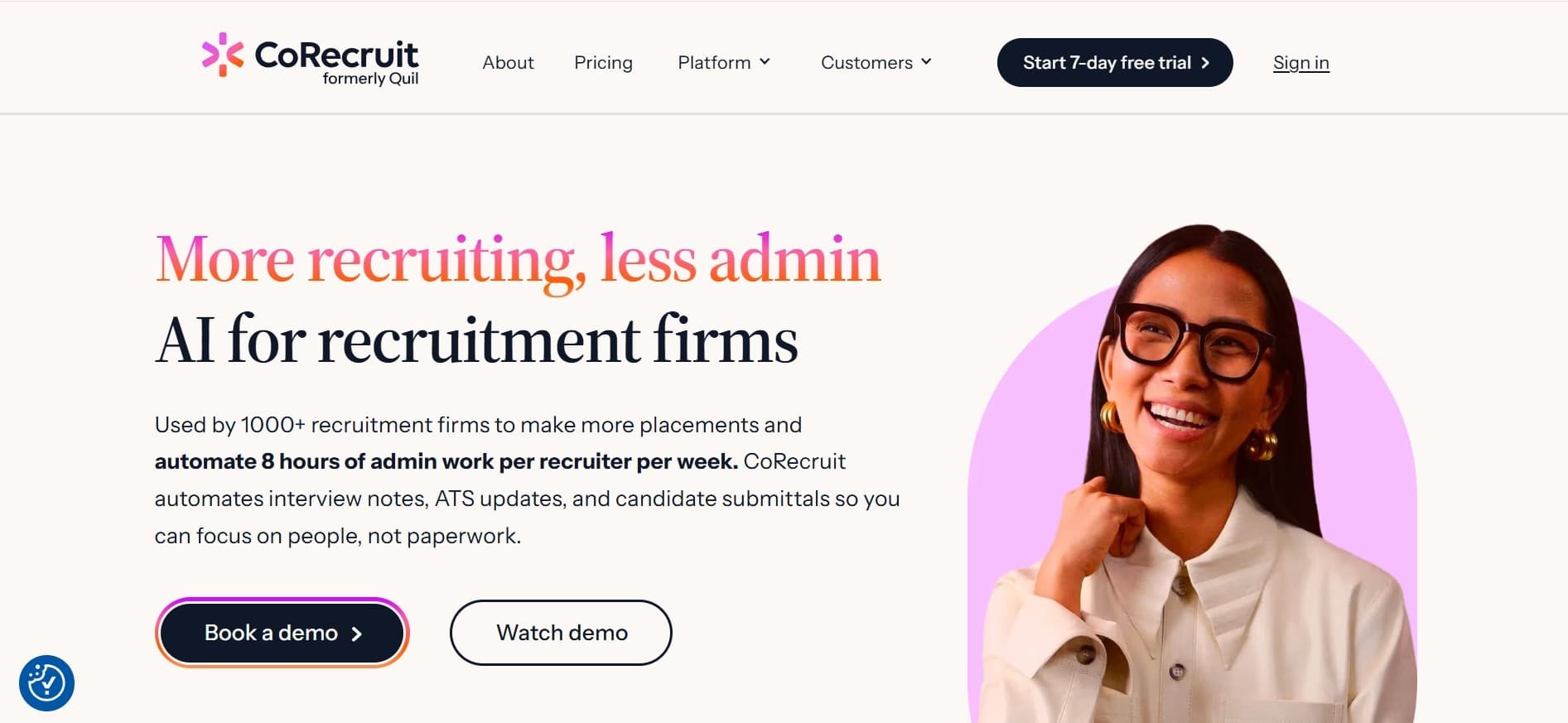
CoRecruit is built to record and structure recruiter conversations, phone, video, or in-person, and push them directly into the firm's CRM. Where most notetakers only join scheduled video meetings, CoRecruit works on standard phone calls without a visible bot joining the room, which is where the bulk of candidate and client conversations in executive search happen. Industry-wide, 91% of recruiter conversations happen over the phone rather than on video, which is the entire reason a phone-first intelligence layer earns its place here more than a Zoom bot does.
What you get:
Best for: search firms where the partner's hour with each candidate or client is the highest-leverage hour in the mandate.
Differentiator: the only tool on this list that handles standard phone calls invisibly, with deep integrations built specifically around agency and search-firm workflows rather than in-house HR.
Pricing model: 7-day free trial, white-glove onboarding, no credit card required.
These tools share a data model built around mandates, off-list candidates, and long relationship cycles, not job reqs. This is where most of the category's real differentiation sits, and where firms tend to spend the most time evaluating before committing.
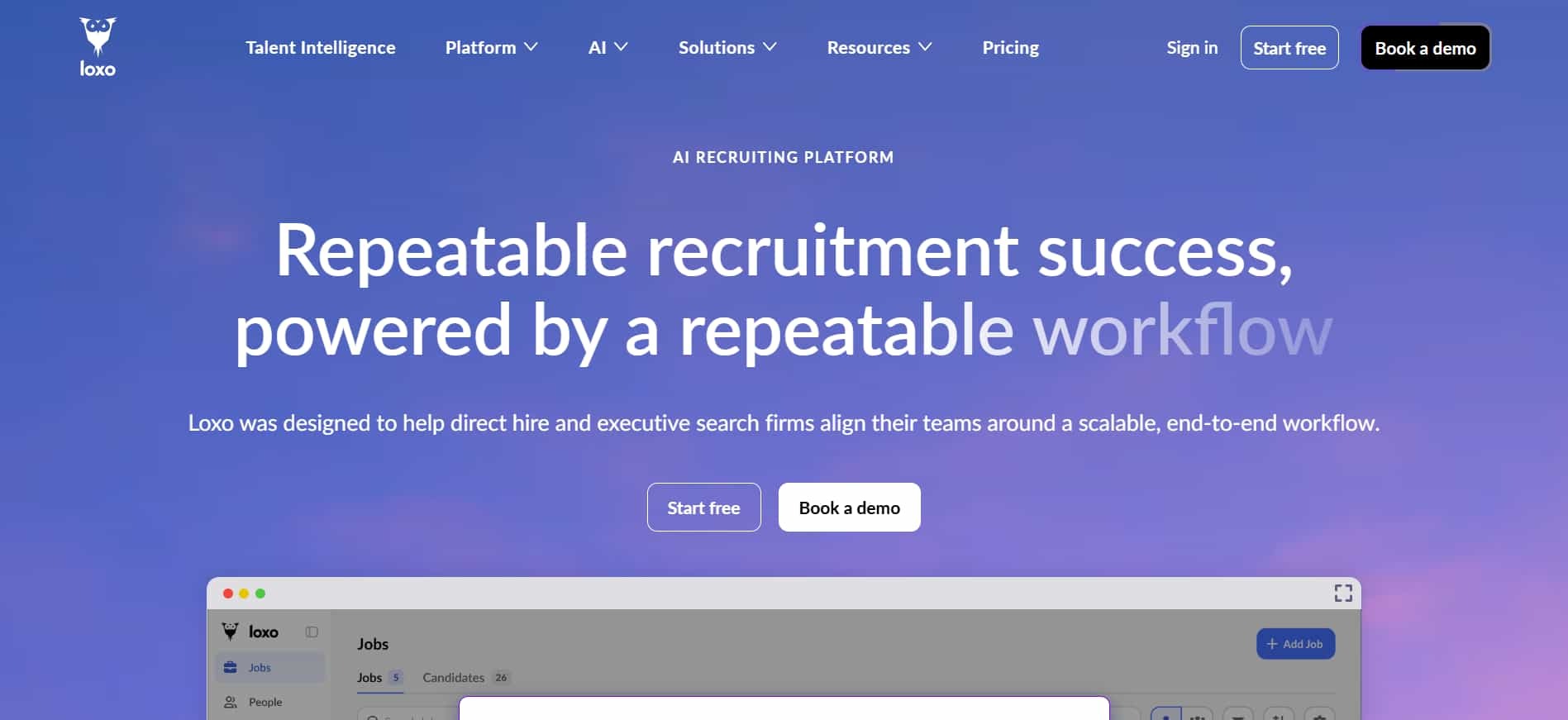
Loxo is a talent intelligence platform combining an AI-powered sourcing engine with a native CRM and ATS. It leans on a large database of professional profiles to surface candidates likely to move, positioning itself as a single system of record rather than a stack of point tools.
What you get:
Differentiator: aims to consolidate sourcing, CRM, and pipeline into one product, reducing the number of separate systems a firm has to maintain.
Best for: firms that want fewer tools and don't already have a deep investment in a separate ATS.
Worth flagging: Loxo is strongest on sourcing and CRM; phone call recording and post-call workflows sit outside its core product, which is where firms typically pair it with an intelligence layer.
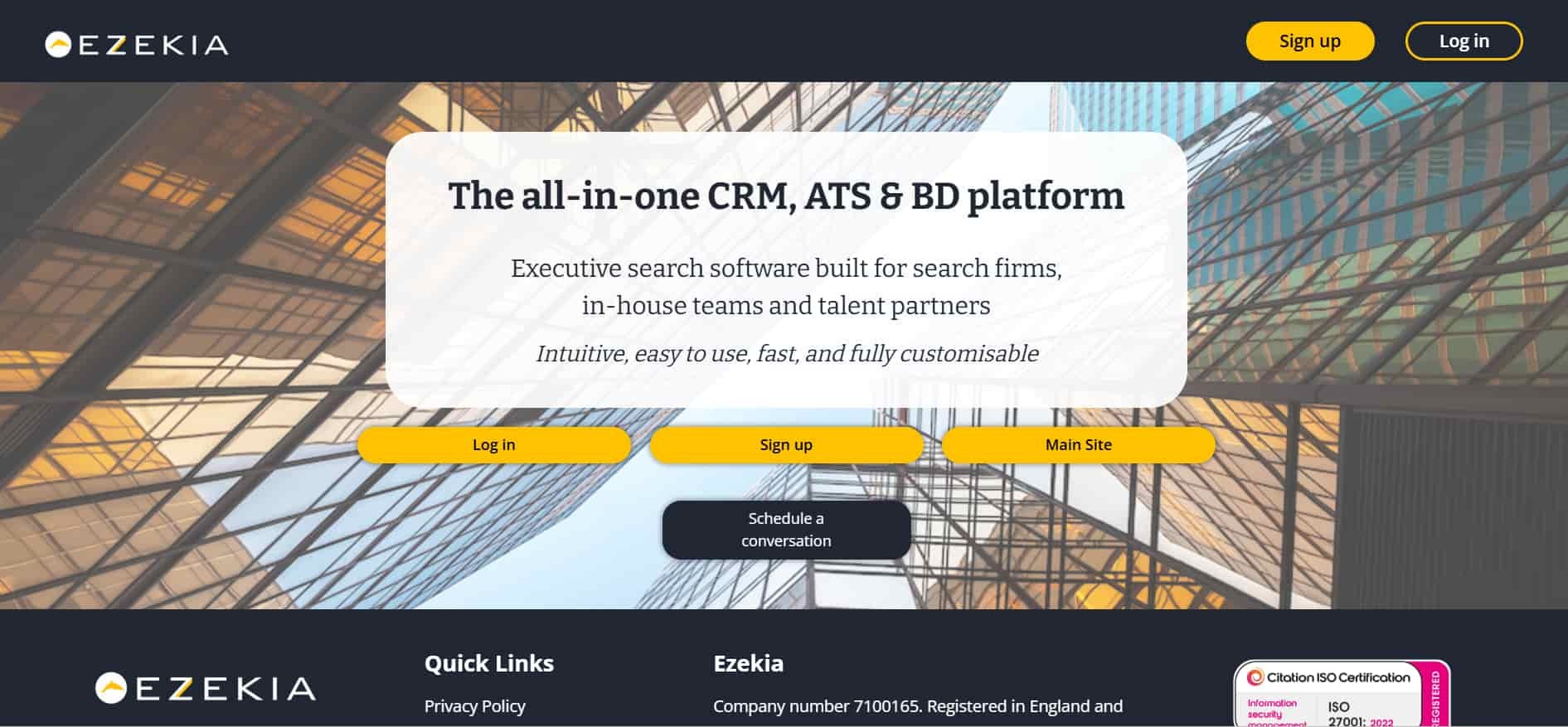
Ezekia is a CRM built specifically for the executive search workflow rather than adapted from a general recruiting tool. The data model is organized around engagements and mandates, with off-list candidate tracking and client-facing portals for sharing progress.
What you get:
Differentiator: one of the few CRMs designed around retained search from the ground up, rather than a staffing or in-house ATS with search features added later.
Best for: boutique to mid-size retained search firms that want a CRM built around mandates instead of job posts.
Worth flagging: a smaller install base than the large general-purpose ATS platforms means fewer out-of-the-box integrations, and pricing runs enterprise-only regardless of firm size.
Thrive TRM is a talent relationship management platform built for executive search firms and in-house teams running mandate-style searches. Its reporting layer includes industry benchmarks on submission rates, time-to-shortlist, and offer-to-acceptance built into the platform.
What you get:
Differentiator: benchmarking against aggregate industry data, which some firms use as a selling point with clients who want proof the search is on pace.
Best for: enterprise executive search firms where benchmarking is part of what the firm sells.
Worth flagging: enterprise-only pricing with a multi-week implementation, which is more overhead than a 1-3 person boutique firm typically needs or can justify.
Clockwork Recruiting is a CRM built around the project-based nature of retained search, with workflows organized by search engagement rather than open requisition.
What you get:
Differentiator: structured around how search firms run individual engagements from kickoff to placement, rather than a generic pipeline view.
Best for: firms running multiple concurrent, project-based searches that need clear engagement-level tracking.
Worth flagging: as with other search-specific CRMs, expect enterprise-style pricing and onboarding rather than a self-serve signup.
Recruiterflow is automation-first: sequencing, candidate enrichment, and pipeline rules sit at the center of the product, with the CRM and ATS underneath.
What you get:
Differentiator: built around outbound automation rather than relationship management as the primary workflow.
Best for: firms whose competitive edge is outbound velocity rather than white-glove mandate management.
Worth flagging: reporting and benchmarking are thinner than what Thrive TRM offers, and heavy automation can feel mechanical if over-configured for a relationship-led search practice.
Recruit CRM is one of the more accessible CRMs in the search-agency category, with a built-in AI layer for resume parsing, candidate matching, and outreach.
What you get:
Differentiator: modern interface and approachable pricing relative to the enterprise-only tools on this list, without feeling like a stripped-down version of a bigger product.
Best for: boutique and mid-size search firms that want a modern CRM without a six-figure annual commitment.
Worth flagging: thinner enterprise reporting than Thrive TRM or the larger staffing ATS platforms; better suited to smaller teams than large multi-partner firms with complex approval chains.
Once the CRM and call-recording layer are in place, these tools fill the top of the funnel: finding candidates, and understanding the market they sit in.
SeekOut is a talent intelligence platform with deep specialized filters, including security-cleared and highly technical candidate pools.
What you get:
Differentiator: depth on specialized and hard-to-source populations that general sourcing tools don't cover well.
Best for: search firms running defense-adjacent, cleared, or highly technical mandates.
Worth flagging: pricing sits well above general sourcing tools, and there's no ongoing free tier once a trial ends, so it's a fit for specialized mandates rather than everyday sourcing.
LinkedIn Recruiter remains the baseline outbound sourcing tool for nearly every search firm, built on a member graph most other tools are still trying to approximate.
What you get:
Differentiator: breadth. No other single sourcing tool covers as many passive candidates or has as complete a professional history on each one.
Best for: every search firm, as the starting point before layering in a CRM and a specialized sourcing tool.
Worth flagging: per-seat pricing gets expensive at scale, and targeting is filter-based rather than context-aware. It doesn't learn from which candidates a firm has placed, so the same manual search discipline is required search after search.
Boutique or mid-size retained search (1-15 consultants). Ezekia or Recruit CRM as the system of record, CoRecruit as the intelligence layer on top of every call, LinkedIn Recruiter as the sourcing baseline. This is the lean stack: three tools, each doing one job well, without an enterprise contract or a multi-week rollout.
Enterprise executive search. Thrive TRM or Loxo as the system of record, especially if benchmarking data is part of what gets sold to clients. CoRecruit for call intelligence across a larger team of consultants. SeekOut layered in for specialized or cleared mandates that come up often enough to justify the added cost.
Individual partner or small practice. Recruit CRM at the low end for the CRM layer, CoRecruit's free trial to get the call-recording habit started without upfront cost, LinkedIn Recruiter for sourcing. Add a specialized tool only once a specific mandate type demands it.
For most retained executive search firms, the AI stack in 2026 looks like this:
Three tools, not ten. Anything beyond that is usually solving a problem the firm doesn't have yet.
If admin time is eating into partner time, the highest-leverage fix is usually the intelligence layer, not another sourcing subscription. A CRM full of stale, half-written candidate notes is the root cause of most of the downstream friction search firms complain about, and it's the one part of the stack that compounds: every mandate after the first one benefits from cleaner historical data.
That's the problem CoRecruit was built to solve.
.svg)


%20LG.svg)

.svg)


