
Comparisons & Lists

Josh Kirkham

Last updated:
November 2026
Read time:
11
mins
What is the best AI sourcing tool for executive search firms?
It depends on what “sourcing” means to your firm. For some, it’s finding the right candidate from a 1.5B profile database before a competitor does. For others, it’s verifying a contact number that doesn’t bounce. For others still, it’s turning an intake call into a shortlist without anyone touching a search bar.
The tools on this list each solve a different part of that problem. None of them solve all of it. The best executive search firms run two or three together rather than relying on one general-purpose tool.
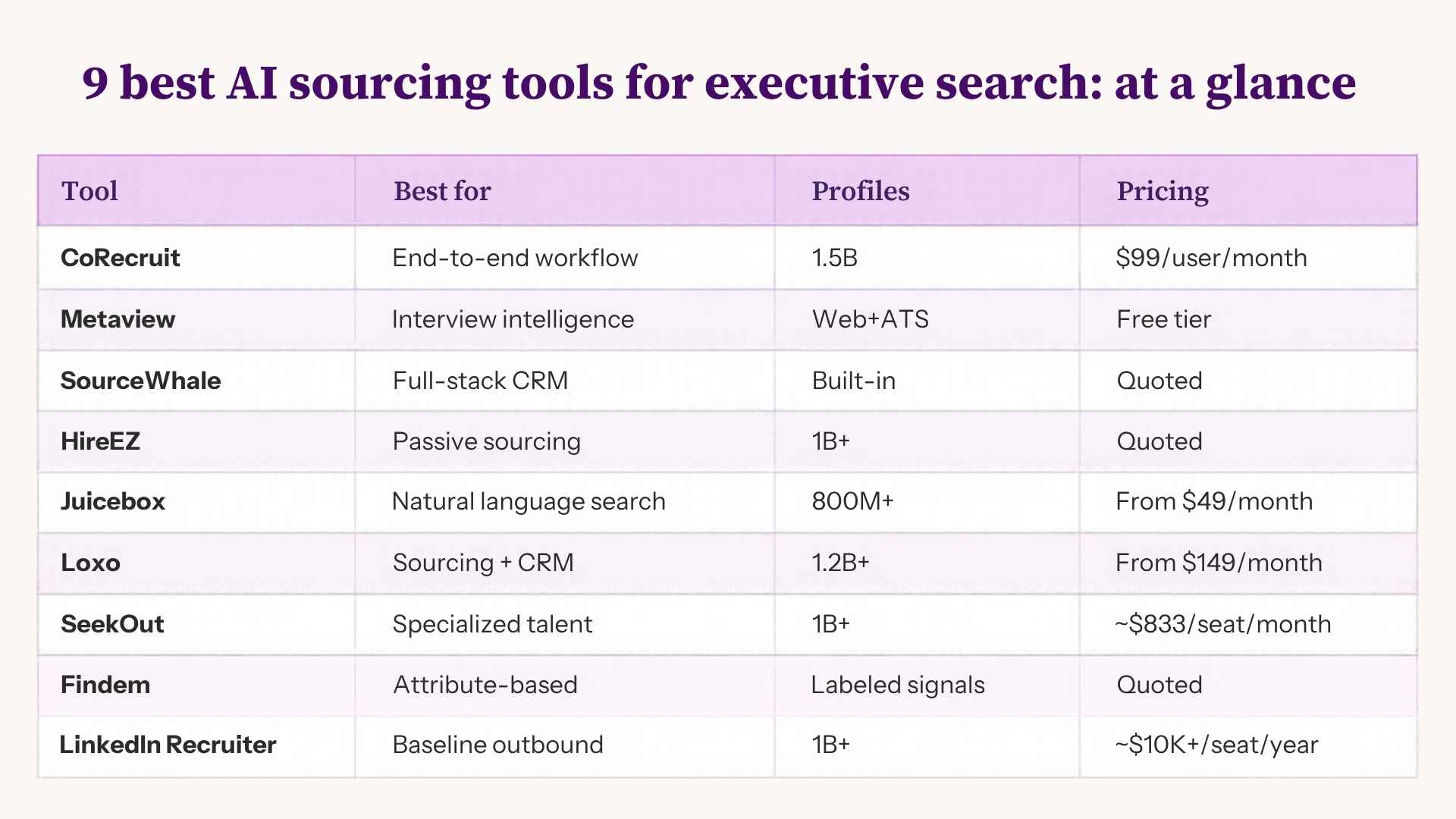
Here are the 9 best AI sourcing tools for executive search firms and staffing agencies in 2026, with honest verdicts on each.
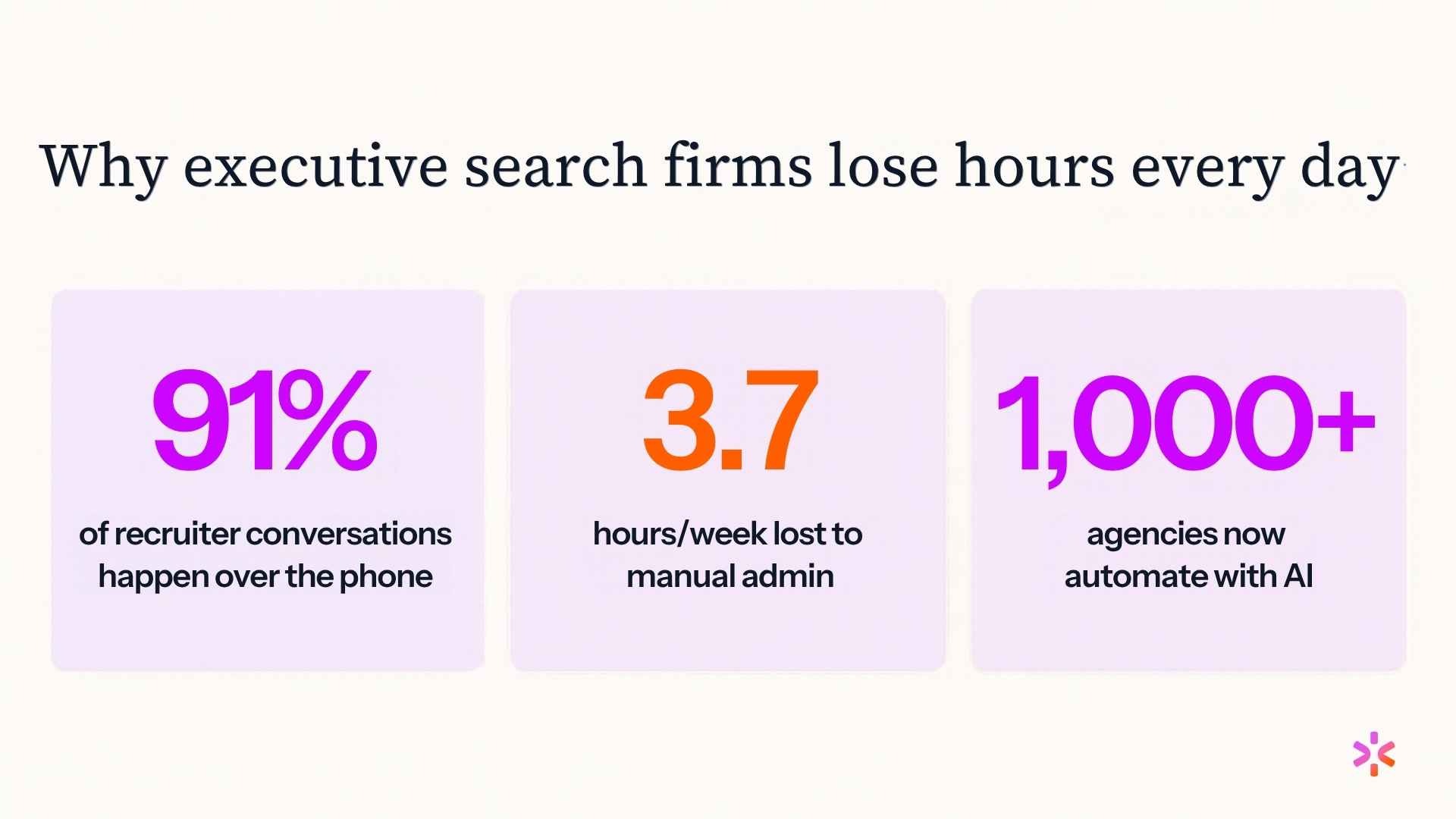
Most sourcing tools are built for in-house corporate TA teams doing high-volume hiring. Executive search is the opposite: low volume, high stakes, long cycles, and candidates who aren’t applying anywhere.
The tools that earn their place in a search firm do four things well:
Find people who aren’t looking. The best executive candidates are working, not browsing job boards. Your sourcing tool needs to surface them from professional profiles, public data, call history, and your own ATS.
Give you a verified way to reach them. A LinkedIn profile is not a contact detail. Verified emails and phone numbers that don’t bounce are what move a search forward.
Connect to the rest of your workflow. Notes from the intake call should auto-draft your search brief. Sourced candidates should flow into your ATS without manual entry. The sourcing step shouldn’t live in a silo.
Not require a Boolean PhD. The best tools in 2026 let you describe what you need in plain language and build the search for you.
Best for: staffing agencies and executive search firms that want sourcing connected to the full recruitment workflow
Pricing: $99/user/month, all-in. 7-day free trial, no credit card required.
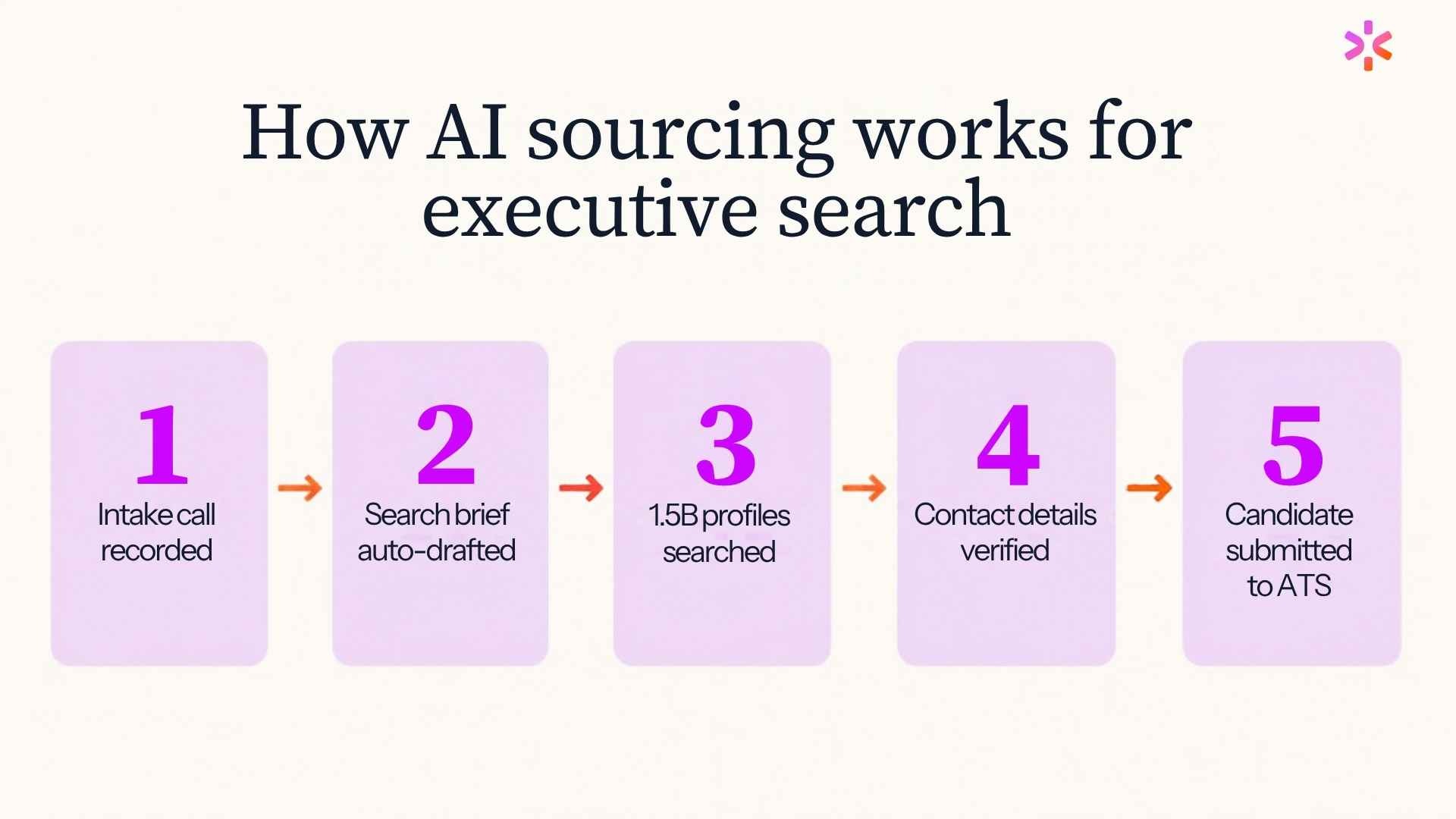
Most sourcing tools stop at the candidate profile. CoRecruit starts there and goes further: it drafts the search brief automatically from your intake call transcript, searches across 1.5B profiles, waterfalls across 20+ data providers for verified contact details, and then — when the call happens — records it botlessly, updates the ATS, and generates a branded candidate submittal ready to send.
That end-to-end workflow is what makes CoRecruit different from every other tool on this list. You’re not running sourcing as a separate step; it’s embedded in the same platform where the call notes live, the ATS updates happen, and the submittal gets generated.
What you get:
Where it falls short: Built for third-party search and staffing. Not designed for in-house corporate TA teams.
Best for: firms that want interview intelligence and AI sourcing from the same platform
Pricing: free with work email, paid plans quoted
Metaview is best known as an interview notetaker, but its AI Sourcing feature is what earns it a place on a sourcing list. It searches across the web, your connected ATS, and — this is the part worth noting — your past Metaview conversations, returning candidates with the reasoning for each match. If a candidate mentioned three months ago that they were open to a CFO role, Metaview can surface them when that mandate opens.
What you get:
Where it falls short: Primarily designed for video interviews. Less suited to firms running high-volume phone-based recruiting. Phone call capture is not the core use case.
Best for: outbound-heavy firms that want sourcing inside a full CRM and outreach platform
Pricing: quoted
SourceWhale isn’t a pure sourcing tool. It’s a full recruitment platform — outreach sequences, native CRM/ATS, dialer, notetaker, and data enrichment — with sourcing built in. For firms that want to consolidate their stack rather than add another point tool, SourceWhale covers more of the workflow than anything else on this list.
The sourcing layer includes verified contact data from leading providers, with a Data Refresh feature to keep records current. The outreach layer runs multi-touch campaigns across email, LinkedIn, SMS, and WhatsApp from a single workflow.
What you get:
Where it falls short: Sourcing is one part of a wider platform, not the core differentiator. For firms that want the deepest possible sourcing capability as a standalone, HireEZ or SeekOut go further. Pricing is quote-only with no published rate card.
Best for: passive candidate sourcing across the widest possible range of platforms
Pricing: quoted, limited trial available
HireEZ indexes 1B+ profiles across 45+ platforms — LinkedIn, GitHub, Stack Overflow, Behance, and more — with AI matching across all of them. For search firms that need to cast a wide net fast across multiple data sources, HireEZ covers more ground than any other pure sourcing tool on this list.
What you get:
Where it falls short: Contact data accuracy is uneven. G2 reviewers flag bounce rates as high as 30% on some segments. Always verify contact details before running high-volume outreach. Works as an add-on layer rather than a standalone system for search firms.
Best for: natural language search and fast shortlists
Pricing: free tier available, paid from $49/month
Juicebox, originally known as PeopleGPT, is the tool that made natural language sourcing feel normal. Type what you’re looking for in plain English, and Juicebox builds the search. No Boolean strings. No filter stacking. Just a description and a shortlist.
What you get:
Where it falls short: Strong at the top of the funnel, thin on everything after it. No CRM, no ATS integration depth, no call capture. Works best as a research layer alongside CoRecruit or a dedicated search CRM, not as a standalone workflow.
Best for: firms wanting sourcing and CRM consolidated in one platform
Pricing: from $149/user/month, free tier available
Loxo combines an AI sourcing engine with a full recruiting CRM and ATS, aiming to be a single system of record rather than a sourcing point tool. For search firms that don’t want to manage a separate sourcing tool and CRM, Loxo cuts the stack meaningfully.
What you get:
Where it falls short: Less depth on the retained search workflow than dedicated search CRMs like Ezekia or Clockwork. AI sourcing depth is thinner than dedicated tools like SeekOut or HireEZ. Better suited to firms mixing contingency and retained work.
Best for: cleared, specialized, and technically deep talent mandates
Pricing: from ~$833/seat/month, 14-day trial
SeekOut is the tool to reach for when a role is hard. 1B+ profiles with unusually deep specialized filters — 3.7M+ security-cleared profiles, rich diversity and veteran data, and technical signal from GitHub and patents. For executive search firms running defense-adjacent, cleared-civilian, or deep technical mandates, SeekOut does work that nothing else on this list can match.
What you get:
Where it falls short: At $833+/seat/month, it’s expensive for general use. Only earns its keep on the mandates where its specialized filters go where LinkedIn can’t. For general executive search, CoRecruit or HireEZ will cover more ground at a fraction of the cost.
Best for: attribute-based sourcing for executive roles
Pricing: quoted
Findem takes a different approach to sourcing. Rather than keyword-and-filter search, it uses what it calls “3D data” — labeled success signals and relationship patterns aggregated from across the web — to identify candidates who match a profile, not just a set of keywords. For executive search where the right candidate has a specific career pattern rather than a specific title, Findem’s attribute-based approach surfaces people that conventional search misses.
What you get:
Where it falls short: Pricing is quote-only with no published rate card. Less commonly used in the UK and European markets. Works best for mid-to-large executive search firms running technical or niche mandates where conventional sourcing keeps returning the same names.
Best for: the baseline every firm needs regardless of what else is in the stack
Pricing: ~$10K+/seat/year
LinkedIn Recruiter is not the best sourcing tool on this list. It is the most necessary one. The 1B+ member graph and InMail credits make it the default starting point for every new mandate. Every firm uses it. The question is what you layer on top of it.
What you get:
Where it falls short: Targeting is keyword-and-filter, not context-aware. At $10K+/seat/year, it’s expensive for what it delivers on its own. It doesn’t learn from which candidates you’ve moved forward, and executives with sparse profiles are effectively invisible to it.
There is no single best AI sourcing tool for executive search. The firms winning mandates in 2026 run two or three of these together rather than relying on one general-purpose platform.
The most practical starting stacks:
For staffing agencies and executive search firms running phone-heavy workflows: CoRecruit as the sourcing and automation layer, LinkedIn Recruiter as the baseline. Add HireEZ if you need to go wider than LinkedIn.
For firms wanting to consolidate their stack: SourceWhale covers sourcing, outreach, CRM, and notetaking in one platform. Less depth on each individual capability, more simplicity in the overall operation.
For cleared and specialized mandates: SeekOut for the search, CoRecruit or Metaview for the call capture. LinkedIn Recruiter for baseline outbound.
For boutique firms and solo consultants: Juicebox for fast, natural language research. CoRecruit for call capture and ATS automation. LinkedIn Recruiter as the foundation.
For firms where interview intelligence matters as much as sourcing: Metaview’s AI Sourcing pulls candidates from your own conversation history — a capability nothing else on this list offers.
Disclaimer: Pricing and features are based on information available at the time of writing and may change over time.


