
Comparisons & Lists

Josh Kirkham

Last updated:
September 2026
Read time:
11
mins
Most sourcing tools for recruiters are built for volume: post a role, source against inbound applicants, fill the pipeline with outbound. Executive search runs on a different premise entirely. A retained search mandate often starts with almost nobody: no applicants, no job posting, just a target list of companies and an assignment to find someone who isn't looking.
That changes what "good" sourcing software looks like. Breadth counts, but so does depth on specific talent pools (cleared, technical, board-level), and so does understanding the market around a target before the first outreach message goes out.
Here are the 8 tools worth evaluating in 2026, with an honest read on where each one earns its place and where it doesn't.
Most search firms run a layered stack rather than a single tool:
The tools below map to those layers. Few firms need all nine. Most need two or three, chosen based on the kind of mandates they run most often.
A word of caution:
No single tool on this list covers sourcing, verification, and market context at once.
Secondly, AI-native search engines (Juicebox, and increasingly HireEZ and Gem) are changing how sourcing queries get written: plain-language descriptions instead of Boolean strings. The output quality is improving fast, but still benefits from a human sanity check before a partner's name goes on an outreach message.
Lastly, executive search leans harder on market-intelligence tools like Crunchbase than high-volume staffing does, because knowing a company just closed a funding round or replaced its CFO is often what makes an outreach message land.
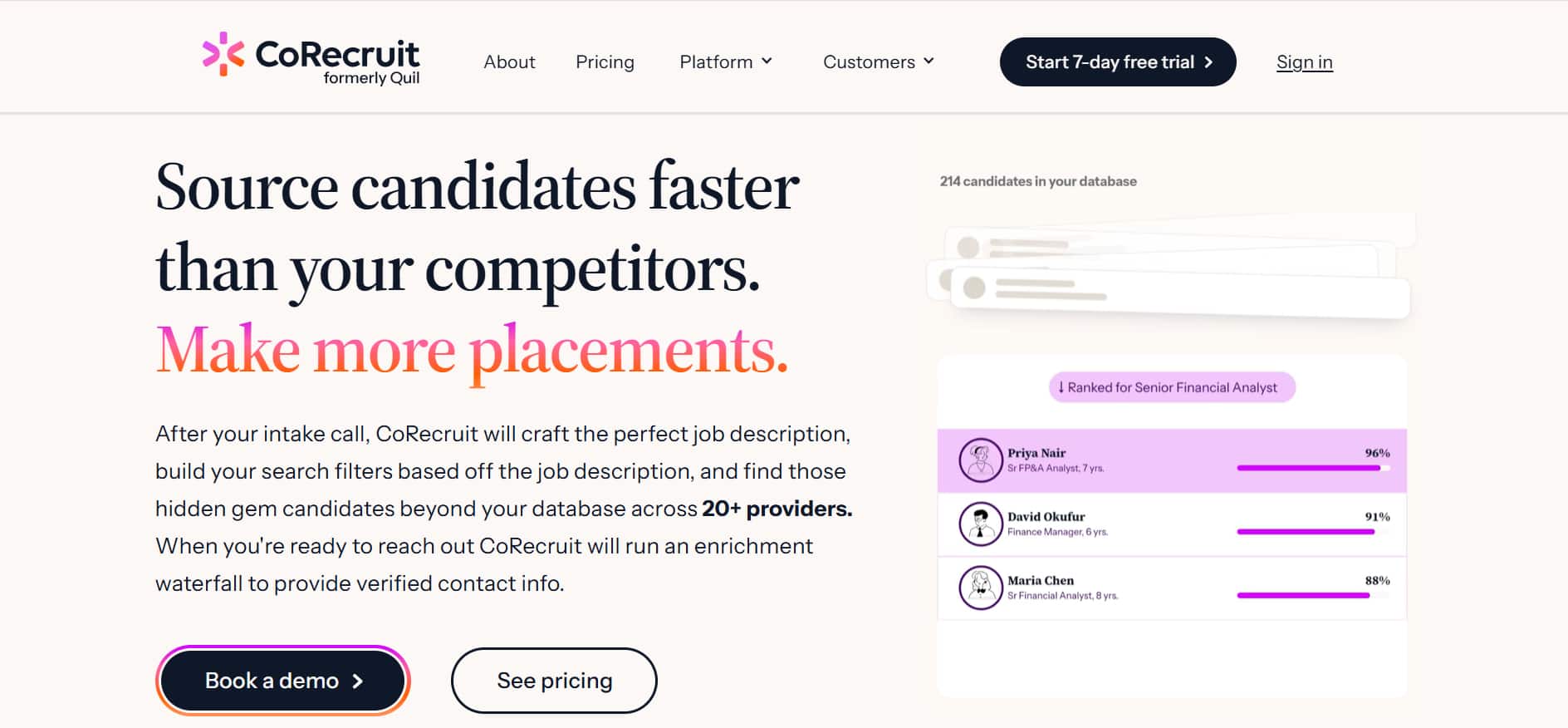
CoRecruit isn't built as a sourcing point tool first. It's a call-capture and ATS automation platform that added sourcing and contact verification directly into that same workflow, rather than selling it as a separate license.
What you get:
Best for: firms already using CoRecruit for call capture and ATS updates who'd rather have sourcing and verification live in that same system than run a separate specialist license.
Worth flagging: this is a newly launched feature set, not an established, decade-old sourcing platform. Firms running heavily specialized mandates, cleared talent or deep technical niches, will likely still want a dedicated tool like SeekOut running alongside it.
LinkedIn Recruiter remains the default starting point for executive search outbound. The scale of its member graph and the ability to search by company, title history, and tenure make it the baseline almost every search firm builds around.
What you get:
Best for: every search firm, as the sourcing layer everything else gets built around.
Worth flagging: per-seat pricing gets expensive at scale, and search is filter-based rather than context-aware. It doesn't learn from which candidates a firm has placed, so the same manual search discipline is required mandate after mandate.
SeekOut is a talent intelligence platform with unusually deep filters for specialized and hard-to-source populations, including a large index of security-cleared profiles.
What you get:
Best for: search firms running defense-adjacent, cleared, or highly technical mandates where general sourcing tools come up short.
Worth flagging: pricing sits well above general sourcing tools, and there's no ongoing free tier once the trial ends. It's a fit for specialized mandates, not everyday sourcing.
HireEZ is built for breadth: an AI-matched sourcing engine pulling from dozens of platforms beyond LinkedIn, paired with built-in outreach sequencing.
What you get:
Best for: search teams running heavy outbound where the top of the funnel needs real volume, not just precision.
Worth flagging: contact accuracy is uneven across segments, with bounce rates that climb noticeably on some populations. Breadth comes with a noise tax that needs a verification step before sequences go out.
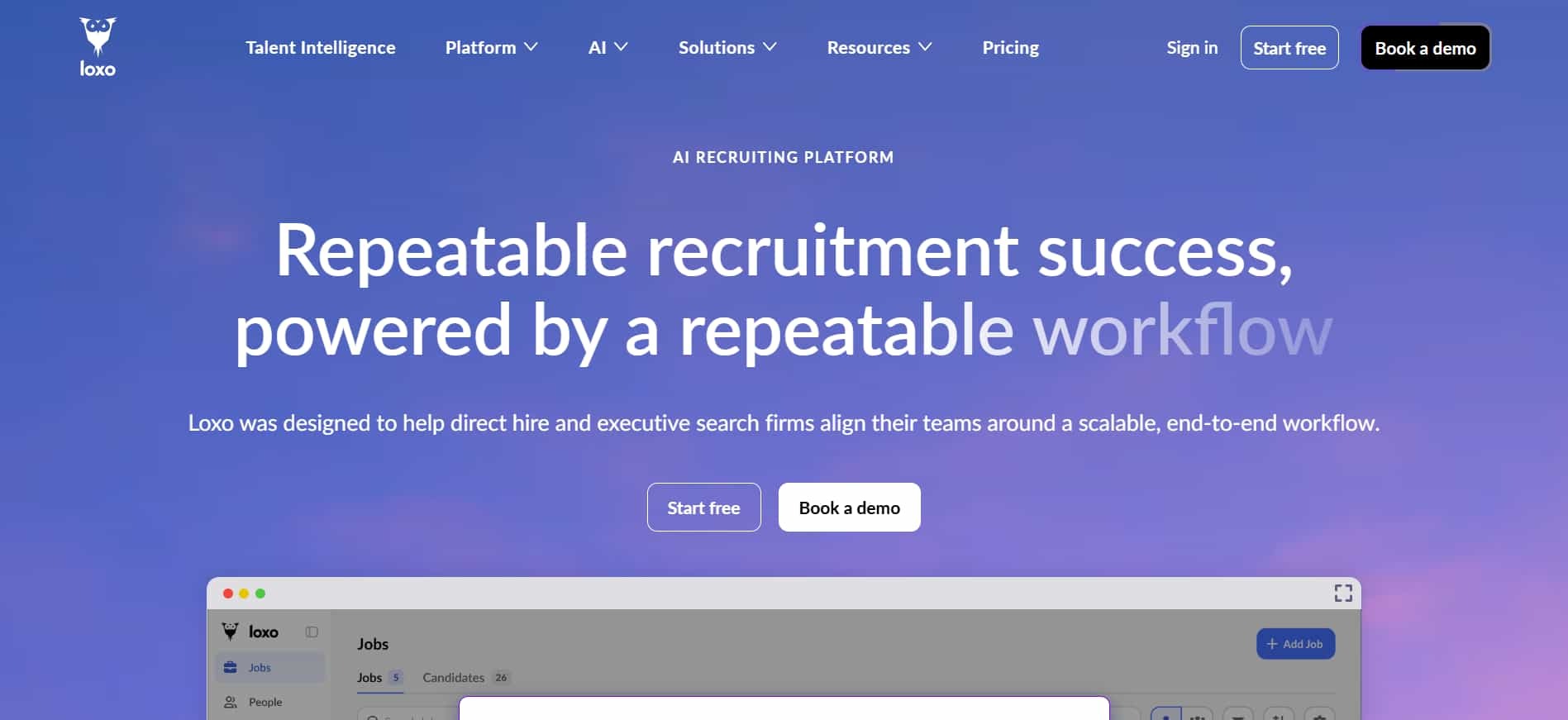
Loxo combines an AI-powered sourcing engine with a native CRM and ATS, aiming to be a single system of record rather than a sourcing point tool.
What you get:
Best for: firms that want to consolidate sourcing and CRM into fewer tools rather than running a specialist stack.
Worth flagging: sourcing and CRM are strong; phone call recording and post-call workflow sit outside the core product, which is where firms typically pair it with a separate intelligence layer.
Crunchbase isn't a sourcing tool in the traditional sense. It's a market-intelligence database that search consultants use to map companies, funding events, and executive moves before reaching out to a target.
What you get:
Best for: partners running tech-sector or venture-backed mandates who need market context before the first message.
Worth flagging: data accuracy varies widely outside the tech sector. For industrial, healthcare, or retail mandates, Crunchbase needs heavy supplementing with direct research.
Gem is a sourcing and outreach platform that has expanded into a fuller CRM, with an AI assistant layer added on top.
What you get:
Best for: high-outbound teams, particularly those already running an Ashby-style in-house stack.
Worth flagging: Gem is built primarily for in-house talent acquisition teams running outbound at scale, not for the mandate-based workflow of a retained search firm. Pricing is enterprise-only.
Juicebox is an AI-native search engine that accepts plain-language queries instead of Boolean strings, aiming to make sourcing accessible without deep query-writing skill.
What you get:
Best for: firms that want to reduce the query-writing skill required to run good searches, or want a second opinion alongside a Boolean-based tool.
Worth flagging: it's a newer platform with a thinner enterprise track record than the established players on this list. Worth piloting on a live mandate before making it a primary tool.
ZoomInfo is a contact and company data platform built for sales, but widely used in executive search to verify and enrich contact details before outreach.
What you get:
Best for: verifying and enriching contact details before a partner sends an outreach message under their own name.
Worth flagging: ZoomInfo is built for sales prospecting, not recruiting workflows. It's a strong enrichment layer, not a sourcing or CRM replacement.
For most retained search firms, the sourcing layer looks like this in practice:
No single tool on this list replaces that stack. The firms that try to run sourcing through one all-in-one platform tend to end up compromising on accuracy, coverage, or context, and end up rebuilding the layered approach a few mandates later anyway.
.svg)


%20LG.svg)

.svg)


