
scroll icon
Scroll to see our services

AI in Recruiting

How do recruiting agencies reduce time-to-fill with AI automation? 

Minahil Mansoor

Last updated:

July 2026

Read time:

8

mins

How Recruiting Agencies Reduce Time-to-Fill With AI? 

Key Takeaways

  • Time-to-fill delays are usually caused by admin lag, not a shortage of candidates: the time between a call ending and that information becoming usable is where most agencies lose the most days.
  • Botless phone recording is the differentiator to check for: 91% of recruiter conversations happen by phone, a channel most video-first notetaking tools don't cover at all.
  • Direct ATS write-back and auto-generated submittals are the two changes with the clearest, most measurable time savings: CoRecruit users report reclaiming 4+ hours a week once both are in place.

Time-to-fill blows up because of a dozen small failures: a call that doesn't get logged for two days, a submittal that takes an hour to write, a scheduling email that sits unanswered. AI automation targets exactly these friction points, not by replacing recruiters, but by removing the admin work that sits between a good conversation and a closed placement.

* Time-to-fill is the time between a job opening getting approved and a candidate accepting the offer.

Here's how staffing and search agencies are using AI to compress the hiring cycle in 2026.
1. How does AI speed up candidate sourcing and rediscovery?

how AI automation reduces time to fill candidates

Every agency has a database full of candidates who were a near-miss for a past role and a perfect fit for the current one. Recruiters rarely have time to search it properly.

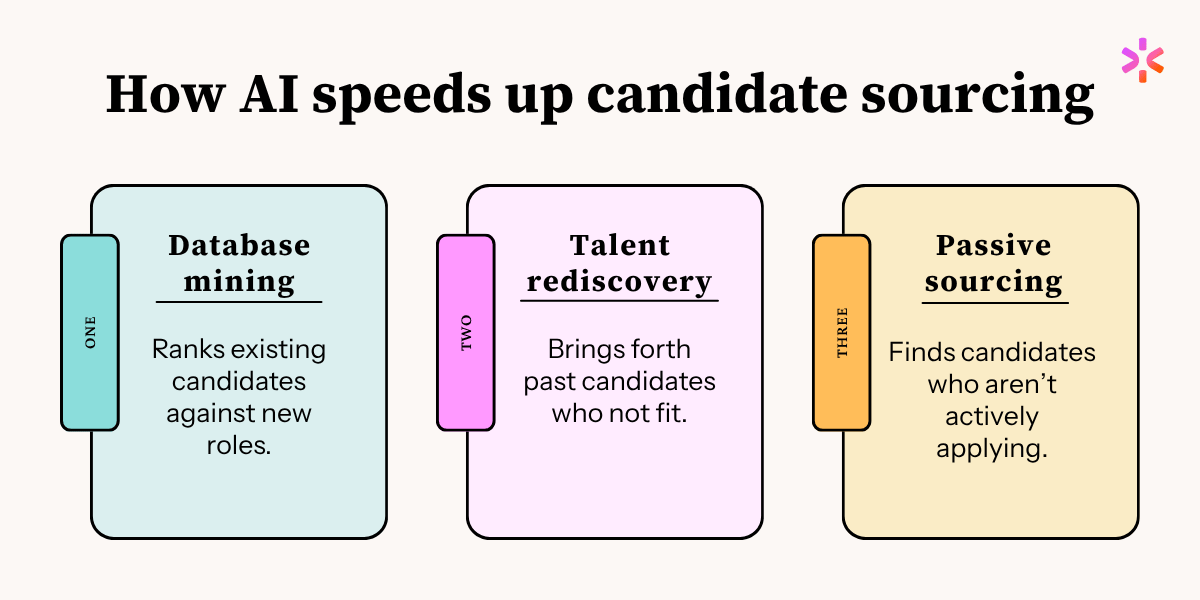
  • Database mining: AI tools scan the ATS and CRM to rank existing candidates against a new job's requirements, instead of recruiters running manual Boolean searches.
  • Talent rediscovery: Sourcing platforms like SeekOut and HireEZ surface previously screened candidates who match the skills required, cutting the "start from zero" phase that adds a week or more to most searches.
  • Passive sourcing: AI agents scan external networks and boards for candidates who fit the role but aren't actively applying.

The agencies with the biggest speed advantage aren't the ones sourcing the most new candidates. They're the ones getting the most value out of candidates they already have.

2. How does AI eliminate ATS admin lag after calls and interviews?

corecruit testimonials

The biggest hidden delay in most agencies is the stretch of time between a recruiter finishing a call and that information showing up anywhere a hiring manager or teammate can see it. If notes sit in a notebook or a recruiter's memory for two days, everyone downstream is waiting on them.

  • Direct ATS write-back: Tools like CoRecruit write structured fields (salary expectations, notice period, skills, availability) straight into the ATS record after a call, with no manual re-entry.
  • Cross-platform sync: CoRecruit integrates with Bullhorn and 20+ other ATS platforms, so this works regardless of which system an agency already runs on.
  • Real-time visibility: Once a call ends, the update is in the system. Teammates and hiring managers aren't waiting on a recruiter to find time to type it up.

This step alone accounts for a meaningful share of the reclaimed hours agencies report. CoRecruit users report getting back 4 or more hours a week once call notes stop requiring manual entry.

3. How does AI shorten the submittal-to-feedback loop?

Writing a candidate submittal, the summary that explains why someone is worth a hiring manager's time, typically takes 30 to 60 minutes of manual work per candidate. Multiply that across a full pipeline and it's one of the largest blocks of unbillable recruiter time in the business.

  • Auto-generated submittals: AI drafts a structured submittal directly from the interview, pulling out the relevant experience, compensation expectations, and fit notes without a recruiter starting from a blank page.
  • Consistent structure: Hiring managers get the same format every time, which speeds up their own read-and-decide process.
  • Faster manager response: Structured, fast submittals get faster feedback than a rushed paragraph typed up two days after the call.

4. How does botless AI notetaking reduce time-to-fill on senior searches?

In executive search and senior-level recruiting, a visible recording bot joining the call changes how candidates talk. Compensation expectations, relocation flexibility, and reservations about a role tend to come out less honestly when someone can see they're being recorded by a third-party tool.

  • Silent, in-the-background recording: Botless tools like CoRecruit record the call without a visible participant joining, on phone or video.
  • More honest early signals: Candidates are more direct about deal-breakers early, which prevents the late-stage fallout that is one of the most common causes of a search dragging past its expected close date.
  • Relevant at scale: Around 91% of recruiter-candidate conversations happen over the phone rather than video, which is exactly where most notetaking tools don't work at all. Botless phone recording covers the part of the process that most competing tools miss.
“Our workload is slashed by hands-free AI that handles the heavy lifting.” - Troy Hendrixson, HQ Resources. 

5. How does AI cut scheduling delays and candidate drop-off?

Strong candidates are often off the market within ten days. Every day lost to back-and-forth scheduling emails is a day closer to losing them to a faster-moving agency or employer.

  • Self-scheduling links: Once a candidate clears initial screening, AI tools send a link reflecting real-time interviewer availability, instead of a recruiter juggling calendars manually.
  • Automated nurture sequences: Personalized status updates and reminders keep candidates engaged between stages, reducing the ghosting that happens when a process goes quiet for a week.

6. How does AI help agencies find and fix pipeline bottlenecks?

Speeding up individual tasks only helps if an agency knows where the actual bottleneck is. AI-powered pipeline analytics flag where candidates are stalling, whether that's a slow-responding hiring manager, a weak sourcing channel, or a screening stage with unusually high drop-off, so agencies can fix a specific, identified delay instead of guessing.

Our word of advice…

The best way to know where to start is looking at where a search gets stuck, whether that's ATS notes, submittals, or scheduling, and fixing that one thing first. Most agencies find it's the same one or two steps slowing them down, over and over, on almost every role. Tools like CoRecruit exist for that reason: to fix the one step that's costing the days.

Try it here: corecruit.com 

Table of Contents

Frequently asked questions

Does AI automation replace recruiters in the hiring process?

No. The tools described here remove admin work, sourcing legwork, and scheduling back-and-forth. The relationship-building, client consulting, and closing still sit with the recruiter.

What is the single biggest time-to-fill delay AI automation targets?

The delay between a call ending and that information being usable, whether that's ATS notes, a submittal, or a scheduling follow-up. Most agencies lose more time here than anywhere else in the pipeline.

Do agencies need a big tech stack to get these benefits?

No. Most of what's covered here, direct ATS write-back, botless call recording, and auto-generated submittals, comes from a single tool sitting on top of an agency's existing ATS, rather than a full platform switch.

A unified recruiting workflow across every device

Stop letting your recruiting firm's most valuable data vanish when the call ends. CoRecruit unifies your video, mobile, and VoIP communications into a single stream of ATS-integrated intelligence.